
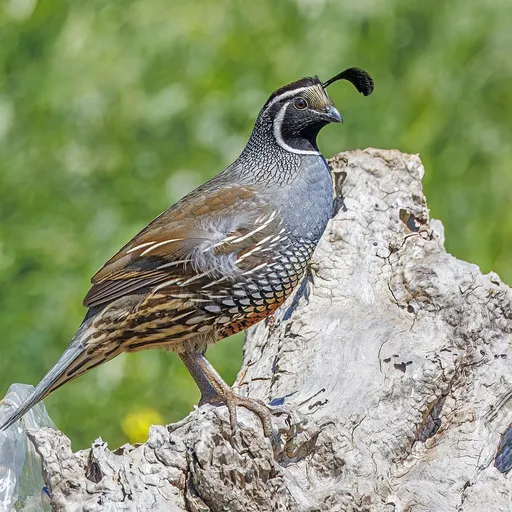
California Quail
Callipepla californica
Least Concern
Overview
The California quail (Callipepla californica), also known as the valley quail, is a small ground-dwelling bird in the New World quail family that inhabits western North America. It serves as the state bird of California, a title established in 1931.
Identification
- Males are grey and brown with a black face outlined by white stripes, while females are a plainer brown and lack facial stripes.
- Both sexes possess a curving crest, plume or topknot that is longer in males than in females.
- Typically measures 24–27 cm in length, has a wingspan of 32–37 cm, and weighs between 140–230 g.
- Vocalisations include the social "chicago" call, contact and warning "pips", and the agonistic "squill" used by males during the breeding season.
Habitat
Native to western North America, particularly the southwestern United States, though it has been introduced to various regions globally. Breeding occurs in shrubby areas and open woodlands, and it maintains nests as shallow scrapes lined with vegetation on the ground beneath cover. It coexists well at the edges of urban areas but is a year-round resident that may decline as human populations increase.
Diet
These birds forage on the ground, often scratching at the soil or feeding at the sides of roads. Their diet consists mainly of seeds and leaves, supplemented by berries and insects, with Toyon berries being a common food source.
Did you know?
Quail were likely introduced to Santa Catalina Island approximately 12,000 years ago by Native Americans, and there is a minimal genetic difference between the island and mainland populations. In a remarkable display of sociability, families often group into multifamily "communal broods" that include multiple females, males, and offspring, with associated males not always being the genetic fathers of the young.
Sources
- Wikipedia · CC BY-SA 4.0
- Wikidata · CC0 1.0