
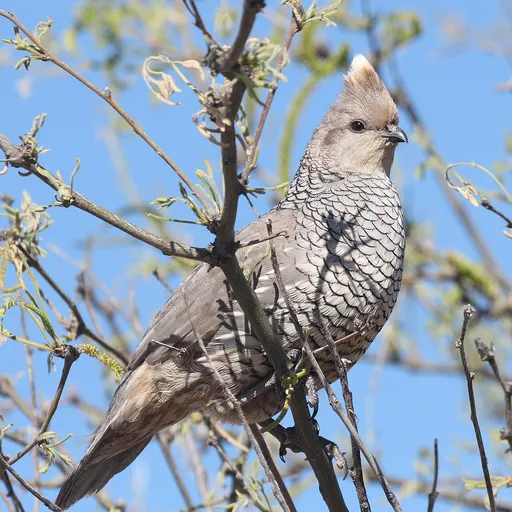
Scaled Quail
Callipepla squamata
Least Concern
Overview
The scaled quail, Callipepla squamata, also known as the blue quail or cottontop, is a species of New World quail characterised by its bluish grey plumage and scaly markings. It is an early offshoot of the genus Callipepla and is classified as Least Concern on the IUCN Red List.
Identification
- Bluish grey body with a scaly appearance on the breast and back feathers.
- Distinguished by a prominent white crest resembling a tuft of cotton.
- Measures 25.4–30.5 cm in length with a wingspan of 38 cm, weighing between 177 and 191 g.
- The chestnut-bellied subspecies (Callipepla squamata castanogastris) is identifiable by its chestnut brown belly.
Habitat
Found in arid regions of the Southwestern United States and Central Mexico, inhabiting dry open valleys, plains, foothills, and rocky slopes with a mixture of bare ground and scattered brushy cover. Its distribution is largely coextensive with mesquite, condalia, and cholla plant communities, and it typically avoids dense growth associated with streamsides.
Diet
Scaled quail are opportunistic feeders that consume seeds year-round, with a particular preference for large seeds such as those from mesquite and snakeweed, as well as grass seeds, leaves, fruits, and insects. In summer, their diet is high in green vegetation and insects, which provide essential moisture, while winter diets rely heavily on broom snakeweed and mesquite seeds.
Did you know?
The male may rear the first brood while the female begins a second clutch, a practice known as double-brooding. When disturbed, these birds prefer to run rather than fly to escape predators.
Sources
- Wikipedia · CC BY-SA 4.0
- Wikidata · CC0 1.0