
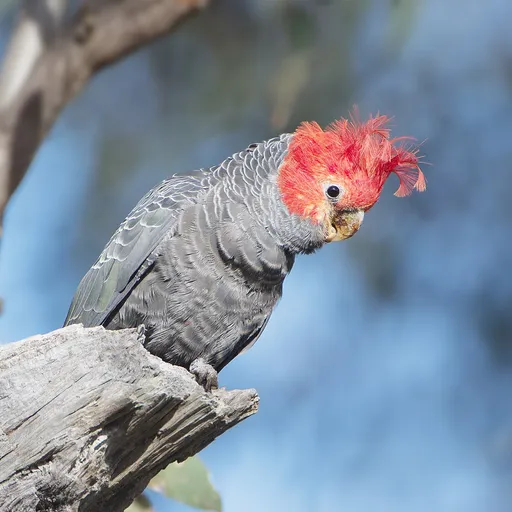
Gang-gang Cockatoo
Callocephalon fimbriatum
Vulnerable
Overview
The gang-gang cockatoo (Callocephalon fimbriatum) is a parrot endemic to the cooler, wetter forests and woodlands of south-eastern Australia. It is the sole species in the genus Callocephalon and serves as the faunal emblem of the Australian Capital Territory.
Identification
- Size: 32–37 cm in length with a wingspan of 62–76 cm.
- Plumage: Mostly mild grey with lighter scalloping on the upperparts; underparts have yellow or pink feather edges.
- Sexual Dimorphism: Males possess a bright red head and crest, whereas females have a small, fluffy dark grey crest.
- Vocalisation: Distinctive call described as resembling a creaky gate or the sound of a cork being pulled from a wine bottle.
Habitat
Found in coastal regions of south-eastern Australia, particularly alpine bushland, forests, and woodlands with dense shrub understories. They migrate short distances into open habitats during winter but return to denser forests to breed. The species is extinct on King Island and has been introduced to Kangaroo Island.
Diet
Gang-gangs forage within canopies, primarily feeding on the flowers and buds of eucalypts.
Did you know?
Unlike most other cockatoos, gang-gangs nest in young, solid trees by excavating cavities with their strong beaks rather than using existing hollows.
Sources
- Wikipedia · CC BY-SA 4.0
- Wikidata · CC0 1.0