
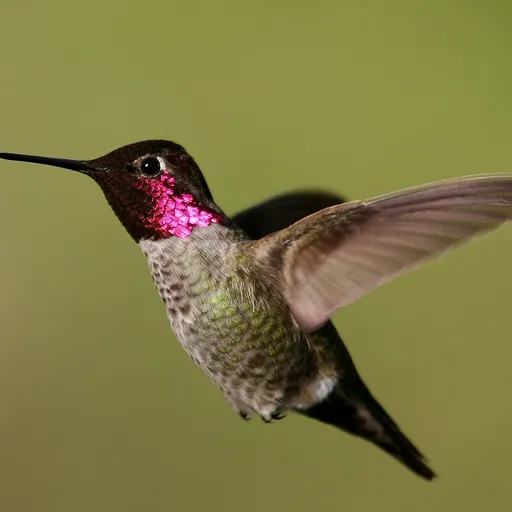
Anna's Hummingbird
Calypte anna
Least Concern
Overview
Anna's hummingbird (Calypte anna) is a North American species named after Anna Masséna, Duchess of Rivoli. This species is classified as Least Concern on the IUCN Red List, with an estimated global population of 9.6 million mature individuals.
Identification
- Length of 9.9 to 10.9 cm with a wingspan of 12 cm, weighing between 2.8 and 5.7 g.
- Iridescent bronze-green back, pale grey chest and belly, and green flanks, with long, straight, slender bills.
- Males display a striking reddish-pink crown and gorget that may appear dull brown or grey without direct sunlight, while females have smaller, less brilliant iridescent red gorgets.
- Males produce a thin, squeaky song interspersed with buzzes and chirps, and an explosive squeak at the bottom of aerial dives.
Habitat
Native to the western coastal regions of North America, ranging from southern Canada to northern Baja California and extending inland to Arizona, Nevada, Utah, and Texas. The species has expanded its range into higher-altitude mountainous terrains and urban environments, such as Seattle, where it resides year-round. They inhabit open-wooded or shrubby areas, mountain meadows, and backyards, often nesting in shrubs, trees, or on artificial substrates.
Diet
These birds feed on nectar from flowers using a long extendable tongue, as well as tree sap and sugar-water mixes from feeders. They also consume small insects and arthropods caught in flight or gleaned from vegetation, including insects trapped in spider webs and occasionally the spiders themselves.
Did you know?
While collecting nectar, Anna's hummingbirds generate an electrostatic charge that adheres pollen to their beaks and feathers, facilitating the transfer of pollen grains to hundreds of flowers per day. They can also shake their bodies 55 times per second to shed rain or remove pollen, applying 34 times the force of gravity on their heads with each twist.
Sources
- Wikipedia · CC BY-SA 4.0
- Wikidata · CC0 1.0