
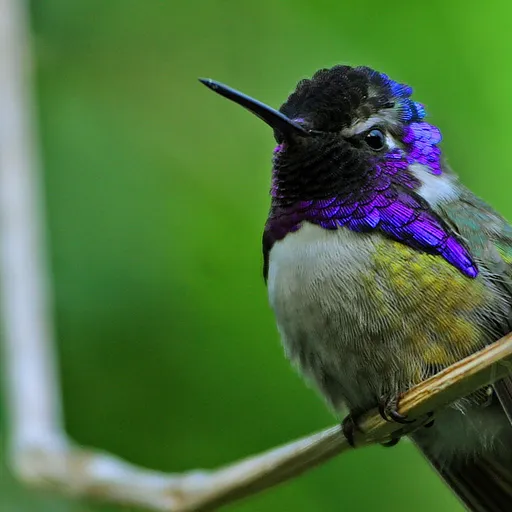
Costa's Hummingbird
Calypte costae
Least Concern
Overview
Costa's hummingbird (Calypte costae) is a small species of hummingbird in the family Trochilidae. It is monotypic, with no subspecies currently recognised, and is classified as Least Concern on the IUCN Red List.
Identification
- Males feature a vibrant purple cap and throat, with throat feathers flaring out and back behind the head.
- Males possess a mainly green back and flanks, a small black tail and wings, and patches of white below the gorgeted throat and tail.
- Females are less distinct, displaying grayish-green upperparts and a white underbelly.
- Mature adults are small, measuring 3–3.5 in (7.6–8.9 cm) in length with a wingspan of 11 cm (4.3 in).
- The male produces a high-pitched, scratch-like song while perched, and a high-pitched vibration from tail feathers during flight displays.
Habitat
Breeds in arid, semi-arid and Mediterranean climate zones of the Southwestern United States and northwestern Mexico, mainly in Southern California and the Baja California Peninsula. Found in wild ecosystems such as conifer and oak forests, chaparral, high desert, and arid brushy deserts, as well as in gardens and on the Pacific coast. Winters in western Mexico when not in the United States.
Diet
Feeds on flower nectar and small insects, similar to other hummingbird species. While feeding in flight, the bird may hover.
Did you know?
During cold nights, the bird can enter a hibernation-like state known as torpor, during which its heart rate and respiration slow substantially. Hybrids with Anna's, black-chinned, and broad-tailed hummingbirds are also known to occur.
Sources
- Wikipedia · CC BY-SA 4.0
- Wikidata · CC0 1.0