
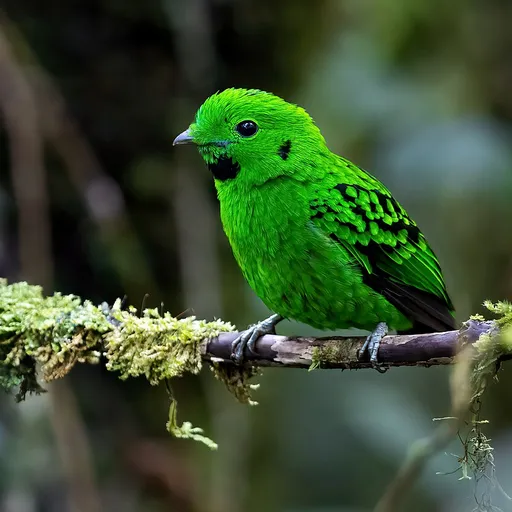
Whitehead's Broadbill
Calyptomena whiteheadi
Least Concern
Overview
Whitehead's broadbill (Calyptomena whiteheadi) is a bird species in the family Calyptomenidae, endemic to the mountain ranges of north-central Borneo. It is the largest species in its genus and is currently classified as Least Concern, although its population is thought to be declining due to habitat destruction.
Identification
- Males are vivid green with a black throat patch, black spots on the ear-coverts and back of the neck, and extensive black markings and streaking on the body, including blackish tails and flight feathers.
- Females are smaller and lack the black markings on the head and underparts, featuring duller green underparts and a smaller forehead tuft.
- The bill is black with a pale lower mandible and is nearly covered by a large forehead tuft, while the feet are olive to greyish-green.
- Characteristic vocalisations include snoring, grinding, and wheezing two-syllable calls such as 'toc-trrr', as well as harsh, grating notes similar to those of woodpeckers.
Habitat
Found in the northern and central parts of Borneo, this species inhabits primary montane forests and forest edges, preferring areas with taller growth. It is most common at elevations of 900–1,700 m, though it can range from 600 m to 1,980 m, and moves locally to follow fruiting seasons.
Diet
The species mainly feeds on fruit, ranging from small berries to large drupes up to 15 mm × 20 mm in size, and supplements this with insects. It has been observed feeding on the strong-smelling fruit of Litsea cubica and hunting moths near lights at dawn. Foraging is usually solitary but can occur in small, noisy flocks near fruiting trees or within mixed-species flocks.
Did you know?
Nests are suspended approximately 15 m above the ground and feature a long extending 'tail' made of lichen and moss, which helps camouflage the structure among the branches.
Sources
- Wikipedia · CC BY-SA 4.0
- Wikidata · CC0 1.0