
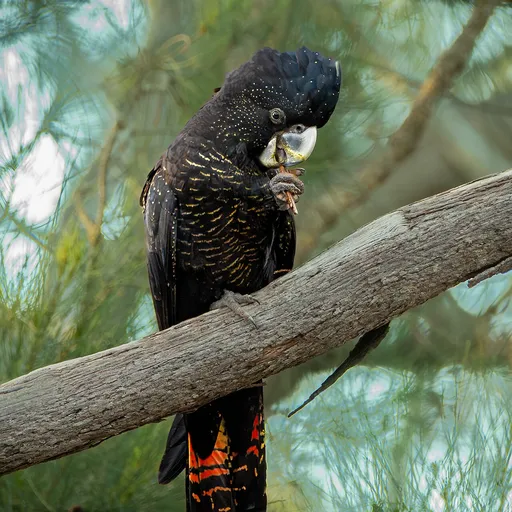
Red-tailed Black Cockatoo
Calyptorhynchus banksii
Least Concern
Overview
The red-tailed black cockatoo (Calyptorhynchus banksii), also known as Banksian or Banks' black cockatoo, is a large black cockatoo native to Australia. Listed as Least Concern on the IUCN Red List, the species is more common in the drier parts of the continent, though certain southern subspecies are under threat.
Identification
- Males have all-black plumage with a prominent black crest and two bright red panels on the tail, while females are black with yellow-orange stripes in the tail and chest and yellow-to-red spots on the cheeks.
- Adults measure around 60 cm in length, with males weighing 670–920 g and females 615–870 g.
- Males possess a dark grey bill, whereas females have a pale, horn-coloured bill.
- The contact call is a rolling metallic krur-rr or kree given while flying, and displaying males vocalise a sequence of soft growling followed by a repetitive kred-kred-kred-kred.
- They have zygodactyl feet with two toes forward and two backward, and are almost exclusively left-footed.
Habitat
The species principally occurs across the drier parts of Australia, found in a wide variety of habitats from shrublands and grasslands through eucalypt, sheoak and Acacia woodlands to dense tropical rainforests. It is dependent on large, old eucalypts for nesting hollows, and populations in southeastern Australia are threatened by deforestation and other habitat alterations.
Diet
The mainstay of their diet is eucalyptus seeds, with a specific relationship to larger-fruited gum species that vary across Australia, such as marri, Darwin woollybutt, and bloodwoods. They feed on a wide variety of native and introduced grains, seeds, nuts, berries, and fruits, though insects are consumed very rarely. They bite off branchlets with clusters of seed capsules, hold them with their feet while chewing, and have also been implicated as agricultural pests of crops like peanuts.
Did you know?
Males court by puffing up their crest and cheek feathers, hiding their beak, and singing and strutting, ending in a jump and a flash of red tail feathers; the female will most often reply by defensively biting him. As with other cockatoos, they can be very long-lived in captivity, with one bird reported over fifty years old at Taronga Zoo in 1938.
Sources
- Wikipedia · CC BY-SA 4.0
- Wikidata · CC0 1.0