
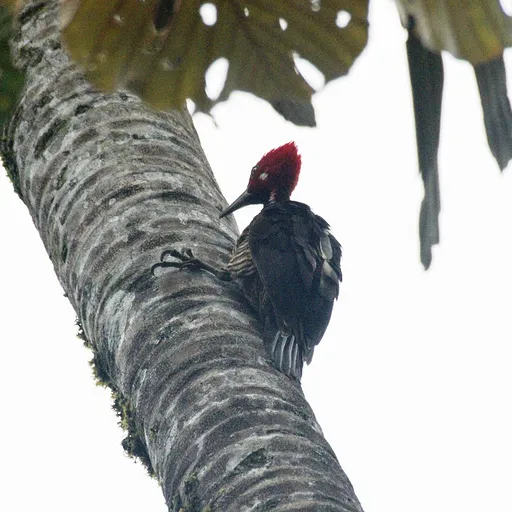
Guayaquil Woodpecker
Campephilus gayaquilensis
Least Concern
Overview
The Guayaquil woodpecker (Campephilus gayaquilensis) is a species of woodpecker belonging to the subfamily Picinae. It is a year-round resident found in South America and is currently classified as Least Concern by the IUCN, although its population is believed to be decreasing due to habitat loss.
Identification
- Size: Measures 32 to 34 cm in length and weighs between 230 and 253 g.
- Plumage: Both sexes have black upperparts with white neck stripes meeting in a 'V'; the lower back and uppertail coverts are barred whitish buff and blackish. Underparts are whitish buff to pale cinnamon-buff with brownish black bars, with a black throat and upper breast.
- Sexual dimorphism: Adult males have an entirely red head with a small black and white spot on the ear coverts, while females lack this spot and possess a wide creamy stripe with black edges extending from the bill to the ear coverts.
- Bill and Features: Possesses a long grayish chisel-shaped bill with a paler mandible, pale yellow irises, and gray-brown to greenish gray legs.
Habitat
The species is distributed from southwestern Colombia's Cauca Department south through Ecuador west of the Andes into northwestern Peru's Department of Cajamarca. It inhabits the interior and edges of dry to humid deciduous forest, as well as mature secondary forest, typically at elevations below 800 m, though it ranges up to 1,100 m in Colombia and 1,500 m in Ecuador and Peru.
Diet
The Guayaquil woodpecker often forages in pairs, usually within the forest canopy. Although its specific diet has not been documented, it is likely similar to that of the closely related crimson-crested woodpecker (Campephilus melanoleucos).
Did you know?
The bird's most common call is described as a liquid, rolling 'kwi-kwi-kwe-rrrrrrr', while its excited calls include 'kwik-kwik-kwikerrr' and 'kik-kwiddit' notes.
Sources
- Wikipedia · CC BY-SA 4.0
- Wikidata · CC0 1.0