
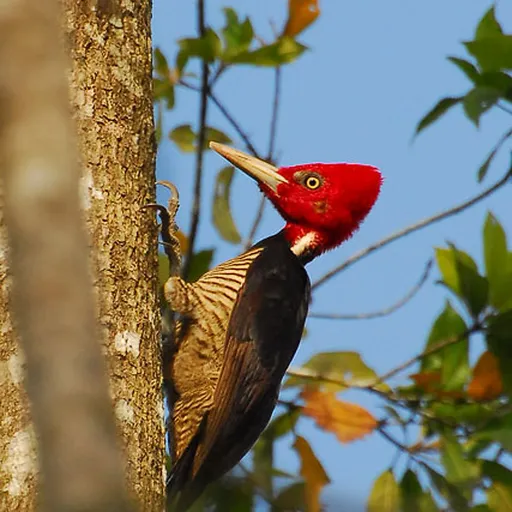
Pale-billed Woodpecker
Campephilus guatemalensis
Least Concern
Overview
The pale-billed woodpecker (Campephilus guatemalensis) is a species of woodpecker belonging to the genus Campephilus. It has a wide distribution across the Neotropics, ranging from Mexico to Panama.
Identification
- Length of 35.5 to 38 cm with a long, ivory-yellow chisel-shaped bill.
- Nominate subspecies features black upperparts with vertical white or buffy-white stripes on the neck forming a 'V', and light yellowish-buff underparts with narrow black bars.
- Adult males have a red head with a bushy crest, whereas adult females have black forecrowns and throats.
- Characteristic calls include a nasal chatter or sputter, low whining notes, and a loud, rapid double rap.
Habitat
Found from Mexico to Panama, this species inhabits the interior and edges of varied forested landscapes, predominantly lowland tropical evergreen forests. On drier Pacific slopes, it occurs in tropical deciduous forests and mangroves, while locally using montane evergreen and pine-oak forests in Honduras. It ranges in elevation from sea level up to 2,000 m, though it shuns extensive deforested areas.
Diet
Foraging mostly in the mid- to upper levels of forests but also on the ground, the pale-billed woodpecker seeks prey on tree trunks and large limbs by excavating decayed wood and scaling bark from dead trees. Its diet is believed to consist mainly of large larvae of wood-boring beetles, along with termites and some small fruits.
Did you know?
Although the breeding season is not fully defined, it varies by latitude, occurring between December and June in southern Mexico and August to September in Costa Rica. Both sexes participate in excavating the nest cavity in large, often dead trees located between 3 and 12 m above the ground.
Sources
- Wikipedia · CC BY-SA 4.0
- Wikidata · CC0 1.0