
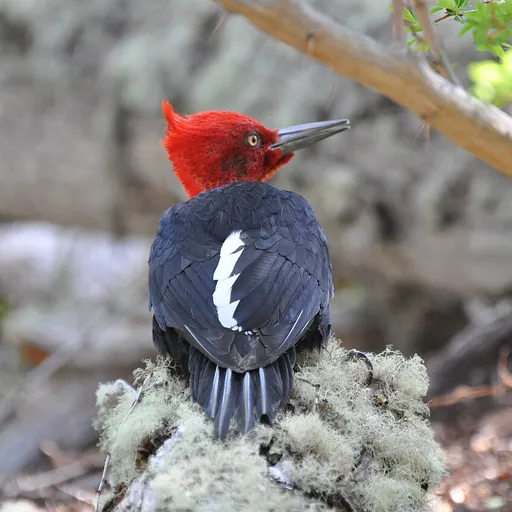
Magellanic Woodpecker
Campephilus magellanicus
Least Concern
Overview
The Magellanic woodpecker (Campephilus magellanicus) is a large species found in southern Chile and southwestern Argentina. It is the largest South American woodpecker and perhaps the heaviest certainly extant woodpecker in the Americas.
Identification
- 36 to 45 cm in length, with males weighing 312–369 g and females 276–312 g.
- Mainly pure black plumage with a white wing patch and a grey, chisel-like beak.
- Males possess a crimson head and crest, whereas females have a mainly black head with a small area of red near the base of the bill.
- Vocalisations include an explosive, nasal call and a loud gargling call, typically produced in series.
Habitat
This resident species inhabits mature Nothofagus and Nothofagus-Austrocedrus forests in southern Chile and southwestern Argentina. Its distribution has contracted due to native forest clearance, particularly in south-central Chile, where it is now restricted to protected and relict areas.
Diet
The bird feeds mainly on wood-boring grubs and adult beetles, as well as spiders, and occasionally supplements its diet with sap, fruits, small reptiles, bats, and the eggs or nestlings of passerines. It generally uses live trees but also feeds on dead substrates, often foraging on humid lower trunks once snow disappears in spring.
Did you know?
Adults normally breed every second year, a feature not documented in any other woodpecker species.
Sources
- Wikipedia · CC BY-SA 4.0
- Wikidata · CC0 1.0