
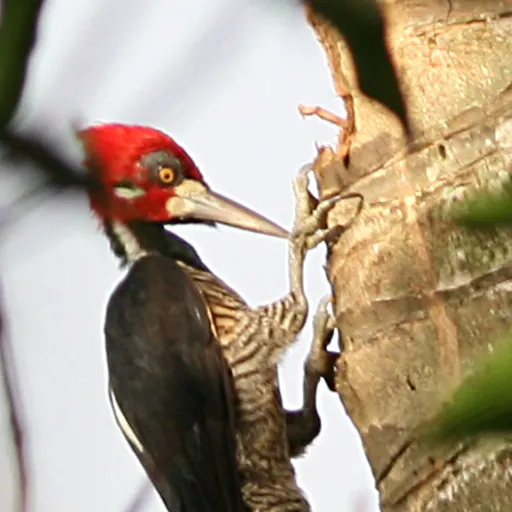
Crimson-crested Woodpecker
Campephilus melanoleucos
Least Concern
Overview
The crimson-crested woodpecker (Campephilus melanoleucos) is a large species of bird in the woodpecker family Picidae. It is one of the largest woodpeckers in its range, found throughout much of tropical South America, as well as in Panama and Trinidad.
Identification
- Measures 33 to 36 cm in length and weighs 225 to 281 g, making it one of the largest woodpeckers in its region.
- Features a long ivory chisel-like bill, white to yellow irises, and legs in variable shades of gray.
- Males display a mostly red head with a white or pale yellow patch at the bill base, while females are black around the eye and front of the crest.
- Produces a variety of calls, including a hollow popping series described as 'tkep-tkep-tkep' and an alarm call of 'ca-wa-rr-r'.
Habitat
Inhabits a wide variety of landscapes, most of them forested, with a preference for large tracts of humid lowland forest such as terra firme, riparian forest, and mature secondary growth. It also occurs in more open areas like plantations, provided tall trees are present. Its range extends across Panama, Trinidad, and mainland South America, excluding Chile and Uruguay.
Diet
Primarily consumes insects such as beetles, butterflies, moths, and ants, though some individuals also feed on termites, small berries, and seeds. It forages at any level of the forest, favouring the mid-level, by pecking, probing, digging, and scaling bark to reach prey. Pairs typically forage together, often on smaller branches than other woodpeckers of similar size.
Did you know?
Although assessed as Least Concern by the IUCN due to its vast range, the species is believed to be losing 16.7-19.3% of its suitable habitat every 15 years due to deforestation, which has reduced the open, continuous forests it requires.
Sources
- Wikipedia · CC BY-SA 4.0
- Wikidata · CC0 1.0