
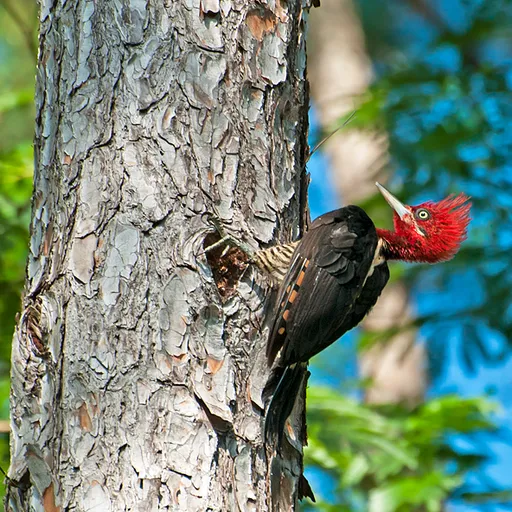
Robust Woodpecker
Campephilus robustus
Least Concern
Overview
The robust woodpecker (Campephilus robustus) is a species of bird in the woodpecker family Picidae. It is a large woodpecker found in South America, specifically in Argentina, Brazil, and Paraguay.
Identification
- Adults are 32 to 37 cm long with whitish upperparts having a pale buff or cinnamon tinge, black scapulars, and black tails.
- Males possess an entirely red head and neck with a small black and white spot on the ear coverts, while females feature a wide whitish strip with black edges from the bill to the ear coverts.
- They have a long, horn-colored chisel bill, white to yellow-white irises, and dark gray legs.
- Vocalisations include a series described as "psó-ko po-po-po-po-rrat" and a drumming sound like a double tap, "to-plóp".
Habitat
Found in eastern Brazil, eastern Paraguay, and northeastern Argentina, this species inhabits intact humid and Araucaria moist forests. It generally avoids disturbed forests unless large trees remain and can be found at elevations ranging from sea level to 2,200 m.
Diet
The robust woodpecker forages at all levels of the forest, particularly the middle level, pecking and hammering vigorously on tree trunks and limb bases to flake off bark. Its diet consists mostly of adult and larval beetles, with some berries, and it usually forages singly, in pairs, or in family groups.
Did you know?
Despite its status as a year-round resident, very little is known about its breeding biology; only a single nest was observed holding young in July after excavation in May.
Sources
- Wikipedia · CC BY-SA 4.0
- Wikidata · CC0 1.0