
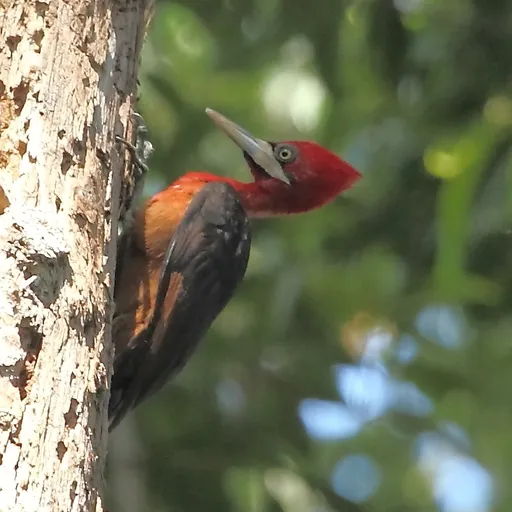
Red-necked Woodpecker
Campephilus rubricollis
Least Concern
Overview
The red-necked woodpecker (Campephilus rubricollis) is a species of bird in the woodpecker family Picidae, specifically belonging to the subfamily Picinae. It is classified as a species of Least Concern on the IUCN Red List, although its population size is not known and is believed to be decreasing.
Identification
- Large body size ranging from 30 to 35 cm in length and weighing between 178 to 236 g.
- Distinctive plumage featuring black to brownish black upperparts, with bright red underparts on the breast that become rufous towards the vent.
- Adult males possess an entirely red head and neck with a small black and white spot on the ear coverts, whereas females lack this spot and have a wide whitish strip with black edges extending from the bill to the ear coverts.
- A long pale grayish white to ivory chisel bill, yellowish white iris, and blackish gray or olive legs.
Habitat
Found in every mainland South American country except Argentina, Chile, Paraguay, and Uruguay. It inhabits rain-, terra firme, and várzea forests within the Amazon Basin, favouring the forest interior but also occurring at edges, in secondary forest, and along watercourses in savannah. Its elevation range is mostly between sea level and 600 m, though it can reach higher altitudes in specific regions.
Diet
The red-necked woodpecker mostly forages on trunks and limbs from the mid-level of the forest to near the canopy, and occasionally near the ground on rotten stubs. Its diet includes the larvae of beetles and moths, along with some fruit. It usually forages in pairs or small family groups.
Did you know?
The most common vocalization of this bird is described as an "explosive nasal call (ngkah-ngkah or kikka)" that is given repeatedly. Its foraging taps vary in volume, and its wings are often noisy in flight.
Sources
- Wikipedia · CC BY-SA 4.0
- Wikidata · CC0 1.0