
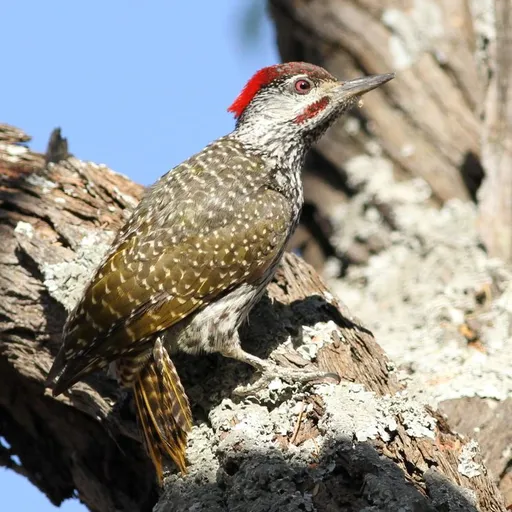
Golden-tailed Woodpecker
Campethera abingoni
Least Concern
Overview
The golden-tailed woodpecker (Campethera abingoni) is a species in the family Picidae, with a specific name commemorating the 5th Earl of Abingdon. It belongs to a species complex that includes the Knysna woodpecker to the south and the Mombasa woodpecker to the northeast.
Identification
- Measures 20 to 21 cm, with southern races weighing about 70 g and the northern race C. a. chrysura weighing approximately 55 g.
- Characterised by barred, greenish upper part plumage and streaked underparts; the golden-olive tail does not differ markedly from related species.
- Sexes are distinguished by head markings: males have red and brown forecrowns with red malar stripes, while females have black, white-spotted forecrowns and mottled malar stripes.
- Vocalisations include a single strident "waaa" or "weeea" call-note, usually by the male, and a repeated long-range "yaooaak-yaaaaaak".
Habitat
It inhabits coastal forest, miombo, mopane and acacia woodlands, showing a preference for riparian woodland, particularly in the drier parts of southern Africa. The species is very widespread in woodlands or forest south of the equator and very localised north of it, ranging from Angola and West Africa to East and Southern Africa.
Diet
It obtains most food by probing and gleaning in the lower to middle strata of trees, though it hammers dead or infected wood more frequently than other Campethera species. Its diet consists mainly of arboreal ants and termites, but also includes millipedes, wood-boring larvae and leaf-feeding moth larvae.
Did you know?
The bird's scientific name commemorates the 5th Earl of Abingdon. Nests are frequently parasitised by various species of honeyguide.
Sources
- Wikipedia · CC BY-SA 4.0
- Wikidata · CC0 1.0