
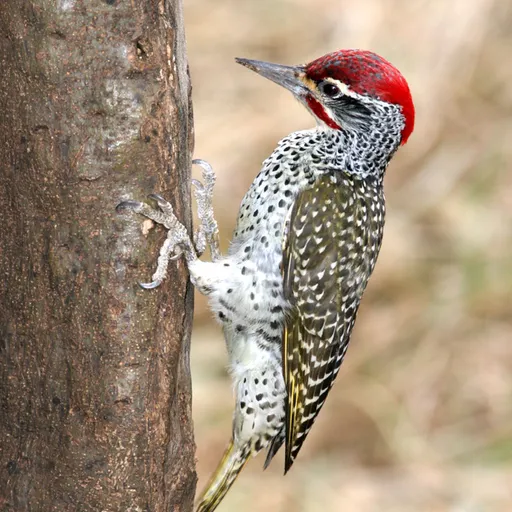
Nubian Woodpecker
Campethera nubica
Least Concern
Overview
The Nubian woodpecker (Campethera nubica) is a medium-sized bird species in the family Picidae. It is a fairly common, non-migratory species found across a wide range in Central and Eastern Africa, where it is currently rated as of 'least concern' by the IUCN.
Identification
- Medium-sized bird measuring approximately 21 cm in length.
- Males feature a red crown and nape with a reddish cheek streak, while females have a black crown speckled with white, a red nape, and a dark cheek stripe with white speckling.
- Upper parts are olive-brown with cream speckling; wings and tail are greenish-brown or greenish-yellow, barred with white or brown.
- Beak is grey with a dark tip, eyes are red or pink, and feet are olive or grey.
- Vocalisations consist of shrill, ringing, or piping notes that are often musical but can sound metallic, frequently sung in duet.
Habitat
Endemic to eastern Africa, its range extends from Chad in the west to Somalia in the east and Tanzania in the south. It typically inhabits open savannah woodland, particularly with Acacia and Euphorbia, as well as bushy areas and scrub. The species is non-migratory and can be found at altitudes up to 2,000 m.
Diet
The Nubian woodpecker forages mostly in trees, though it also forages on the ground. Its diet consists primarily of ants and termites, supplemented by spiders and beetles.
Did you know?
The genus name Campethera is derived from the Ancient Greek words kampē meaning 'caterpillar' and -thēras meaning 'hunter'.
Sources
- Wikipedia · CC BY-SA 4.0
- Wikidata · CC0 1.0