
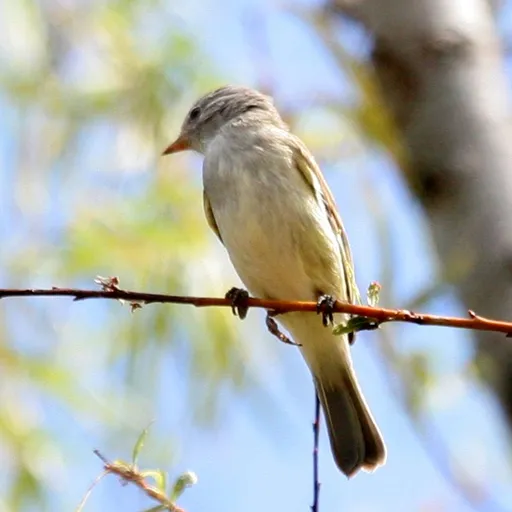
Southern Beardless Tyrannulet
Camptostoma obsoletum
Least Concern
Listen
XC1032074 · Gean Carlo Valdés · Islas secas, Panama · CC0 1.0
Overview
The southern beardless tyrannulet (Camptostoma obsoletum) is a small passerine bird belonging to the tyrant flycatcher family, Tyrannidae. It is characterised by its extensive distribution across the Americas and its adaptability to a wide variety of environmental conditions.
Identification
- Length of 9.5 to 10.5 cm with a weight of 7 to 9 g, featuring a long pointed warbler-like bill and a grayish crown that is often bushy with dark centers.
- Underparts are mostly pale yellow with a faint olive wash on the breast, contrasting with medium olive-gray upperparts and a grayish white throat.
- Wings display two wide bars formed by cinnamon tips on the wing coverts, and the bird possesses a brown iris with a dull orangish or pinkish mandible.
- Vocalisations include a thin, high whistle described as 'fleeeeer', often accompanied by the bird raising its crest.
Habitat
This species is found in almost every habitat type within its range, including desert with cactus, thorn-scrub, deciduous and gallery forest, secondary forest, and even parks and gardens in built-up areas. While it generally avoids the interior of continuous humid forest, it occasionally inhabits várzea and swamp forests, reaching elevations up to 2,800 m in western Ecuador.
Diet
The bird primarily feeds on insects and spiders, but also consumes berries such as mistletoe and other small fruits. It forages actively alone or in pairs, occasionally joining mixed-species flocks, by gleaning prey from perches in the crown of trees or hovering briefly to catch food.
Did you know?
Nests of the southern beardless tyrannulet are frequently placed near active wasp nests, with a study in Ecuador revealing that 12 out of 20 observed nests were located in proximity to these stinging insects.
Sources
- Wikipedia · CC BY-SA 4.0
- Wikidata · CC0 1.0