
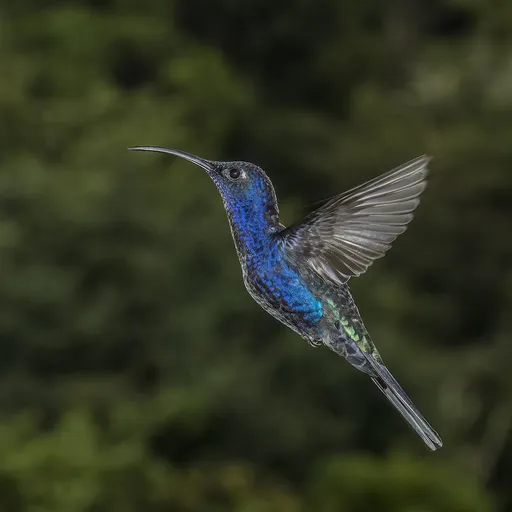
Violet Sabrewing
Campylopterus hemileucurus
Least Concern
Listen
XC544024 · Oliver Komar · San Pedro Sula, Departamento de Cortés, Honduras · CC BY-SA 4.0
Overview
The violet sabrewing (Campylopterus hemileucurus) is a species of hummingbird found in the emeralds tribe. It is the largest hummingbird in Mexico and Central America, ranging from Mexico to Panama.
Identification
- 13 to 15 cm long, weighing 9 to 12 g.
- Males feature metallic violet-blue underparts that are bluer on the belly, with green upperparts and a dusky crown; C. h. mellitus males have nearly entirely violet underparts.
- Females have a violet-blue throat, mostly grey underparts with metallic green spots along the sides, and green to bronze upperparts.
- Bill is black, with C. h. mellitus males possessing longer bills than the nominate subspecies.
Habitat
The species inhabits the edges and interiors of humid evergreen montane forests, mature secondary forests, banana plantations, and gardens. In Mexico, it generally occurs between 500 and 2,000 m, though it reaches up to 2,500 m, while in Costa Rica it ranges from 1,500 to 2,400 m.
Diet
This bird primarily feeds on nectar by trap-lining a circuit of flowering plants, often foraging in the understory on Heliconia, banana, Cephalism, and Palicurea. It also consumes arthropods gleaned from foliage and spiderwebs, and is known to chase other hummingbirds from sugar water feeders.
Did you know?
The song of the violet sabrewing is described as high-pitched, piercing, and ventriloquial, consisting of varied loud chipping and warbles punctuated by sharp, slightly explosive notes.
Sources
- Wikipedia · CC BY-SA 4.0
- Wikidata · CC0 1.0