
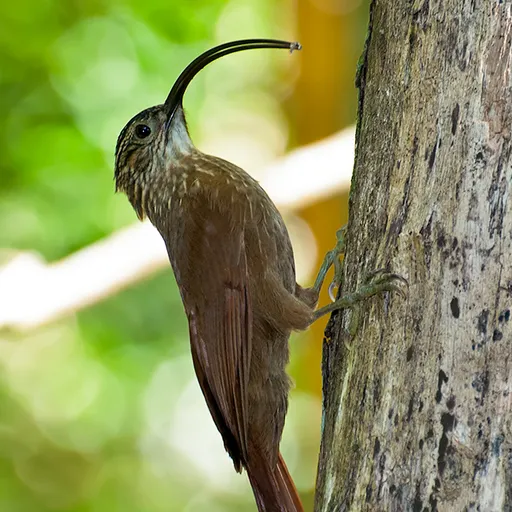
Black-billed Scythebill
Campylorhamphus falcularius
Least Concern
Overview
The black-billed scythebill (Campylorhamphus falcularius) is a medium-sized bird in the ovenbird family Furnariidae, native to the Atlantic Forest. It is classified as Least Concern by the IUCN, though its population is believed to be decreasing and it is considered rare to locally uncommon in most of its range.
Identification
- A slim, medium-sized woodcreeper measuring 24 to 28 cm long, featuring a very long, slim, and dramatically decurved bill that is brownish black to black.
- Plumage includes a thinly streaked buff and blackish face with a narrow buffy-white supercilium, blackish crown and nape with thin whitish to ochre streaks, and brownish to olive-brown upper parts.
- Wings, uppertail coverts, and tail are rufous-chestnut with blackish primary tips and tail shafts, while underparts are pale brown to olive-brown, becoming more cinnamon on the undertail coverts.
- Legs are yellowish green, greenish gray, or dark gray in adults, while juveniles have brown legs and shorter bills.
- Song consists of a level or descending, raspy 'sree-sree-sree-' repeated five or six times, accompanied by a very high, piercing 'pjeetpjeet' call.
Habitat
Found from southeastern Brazil's Bahia state south into northern Rio Grande do Sul, eastern Paraguay, and northeastern Argentina, the species primarily inhabits the humid and semi-deciduous Atlantic Forest. It favours mature evergreen forest, cloudforest, mature secondary forest, and thickets of Guadua bamboo, extending into drier caatinga and cerrado where forest penetrates. Elevation ranges from near sea level to at least 1,600 m, though it is seldom found below 600 m in the northern part of its range.
Diet
The diet is virtually unknown, with the one stomach examined containing only arthropods. The bird usually forages singly or in pairs, and regularly joins mixed-species feeding flocks. It hitches up and along trunks, branches, and bamboo, mostly from the understory to the subcanopy, taking prey by probing crevices and holes in bark, bamboo, bromeliads, and epiphytes.
Did you know?
As a forest-dependent species, it is believed to be highly sensitive to human disturbance, having been present only in the largest fragment surveyed in one study and not recorded at all in most studies concentrating on forest fragments.
Sources
- Wikipedia · CC BY-SA 4.0
- Wikidata · CC0 1.0