
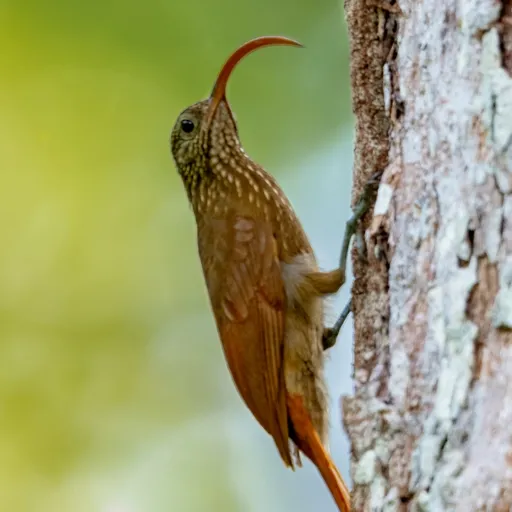
Curve-billed Scythebill
Campylorhamphus procurvoides
Least Concern
Overview
The curve-billed scythebill (Campylorhamphus procurvoides) is a species of bird in the ovenbird family Furnariidae. It is a slim, medium-sized woodcreeper found throughout the Amazon Basin and Guianas in South America. Classified as Least Concern by the IUCN, it is considered uncommon and patchily distributed across its very large range.
Identification
- Size and Build: 22.5–25 cm long; slim body with a very long, slim, dramatically decurved bill.
- Plumage: Adults (nominate) have a dark brown head and neck with thin whitish streaks; olive-brown back; rufous-chestnut flight feathers, rump, and tail; dull brown underparts with buffy-white arrow-shaped marks narrowing to streaks on the belly; cinnamon-rufous underwing coverts.
- Bill and Legs: Bill is dark red to reddish brown (often with a dusky brown base); legs are dusky green, brown, or dark grey.
- Vocalisation: Nominates sing at dawn in short bursts of 7–9 accelerating whistles (e.g. 'weeee, weé, wee, we, we, wew'); all subspecies give an explosive, harsh call described as 'chit-di-dit'.
Habitat
The curve-billed scythebill inhabits humid evergreen forest throughout the Amazon Basin and Guianas, greatly favouring terra firme forest but occasionally using floodplain forest and bamboo thickets. It strongly prefers the forest interior, though it may visit edges, and generally occurs below 500 m (occasionally up to 700 m). It is highly sensitive to habitat modification, requiring nearly continuous forest and quickly abandoning fragmented patches.
Diet
The diet is mostly or entirely arthropods. Birds forage as individuals or pairs, usually joining mixed-species feeding flocks in the forest understory and mid-level (occasionally the subcanopy). They glean and probe along trunks, branches, vines, and bamboo, hitching upward as they feed.
Did you know?
It breeds by nesting in cavities in trees, including those excavated by woodpeckers, and lays a clutch of two eggs. The breeding season is poorly defined but appears to include at least February to April.
Sources
- Wikipedia · CC BY-SA 4.0
- Wikidata · CC0 1.0