
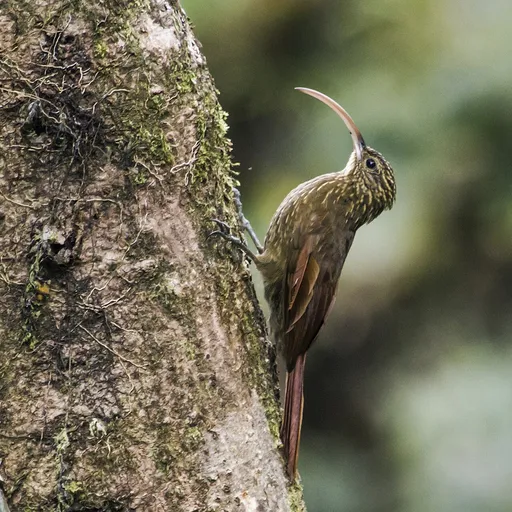
Brown-billed Scythebill
Campylorhamphus pusillus
Least Concern
Listen
XC248245 · Niels Krabbe · Esmeraldas: El Placer, Ecuador · CC BY-SA 4.0
Overview
The brown-billed scythebill, Campylorhamphus pusillus, is a slim, medium-sized woodcreeper belonging to the ovenbird family Furnariidae. Classified as Least Concern by the IUCN, it is a year-round resident across a large range in Central and South America, though its population is believed to be decreasing.
Identification
- A 20 to 25 cm bird with a very long, slim, dramatically decurved bill that is blackish brown to brownish horn.
- C. p. pusillus adults feature a deep reddish brown back, rufous-chestnut wings and tail, and dark brown to olive-brown underparts that become more rufescent on the lower belly.
- The face and neck are streaked buff and blackish brown with a faint buffy supercilium, while the crown and nape are dark brown with thin deep buff streaks.
- Legs and feet are olive-green to blackish brown, and the iris is dark brown to cinnamon-brown; juveniles are darker, more olivaceous, and have shorter, darker bills.
Habitat
Found in Colombia, Costa Rica, Ecuador, Panama, Peru, and Venezuela, the brown-billed scythebill inhabits humid evergreen forest, favouring middle-elevation cloudforest in the interior and on edges. It occurs mostly in highlands but locally in lowlands, with elevational ranges varying by region, from as low as 250 m in Colombia to as high as 2,500 m in southern Costa Rica.
Diet
The diet consists mostly of arthropods, which it forages for by hitching up and along trunks and vines from the understory to the subcanopy. It typically takes prey from the surface of the substrate and also probes crevices and holes in bark, bromeliads, epiphytes, moss, and vine tangles. It usually forages singly or in pairs, but very often as part of a mixed-species feeding flock.
Did you know?
Although its breeding season appears to include May to July, it forms long-term pair bonds, yet almost nothing else is known about its breeding biology. Its highly variable song is complex, consisting of a soft, twittering trill followed by loud, often descending and quavering whistles lasting 2.5 to 5 seconds.
Sources
- Wikipedia · CC BY-SA 4.0
- Wikidata · CC0 1.0