
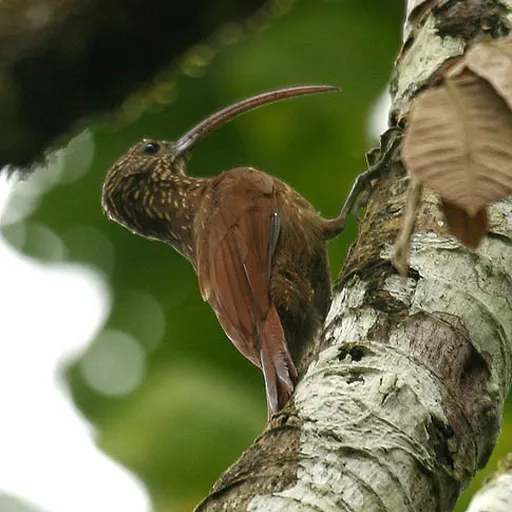
Red-billed Scythebill
Campylorhamphus trochilirostris
Least Concern
Listen
XC801150 · Rosa Elena Albornoz · Cecilio Acosta (near Caracas), Guaicaipuro, Miranda, Vietnam · CC0 1.0
Overview
The red-billed scythebill is a slim, medium-sized woodcreeper within the ovenbird family Furnariidae, distinguished by its long, dramatically decurved bill. Classified as Least Concern by the IUCN, it maintains a very large range with an estimated population of at least 500,000 mature individuals across South and Central America.
Identification
- Size: 22 to 28 cm long, weighing 30 to 55 g, with a very long, slim, and dramatically decurved bill.
- Plumage: Reddish olive-brown crown, nape, and back, contrasted with rufous-chestnut rump, flight feathers, and tail; underparts are brown with buff streaks on the breast, while the throat and chin are white with thin brownish streaks.
- Facial Markings: A thinly streaked face and neck featuring a weak supercilium, with a dark brown to hazel iris.
- Song: Vocalisations vary significantly by region, ranging from rapid descending whinnies in Venezuela to series of fluted notes that ascend at the end in northeastern Brazil.
Habitat
The species inhabits a wide variety of wooded landscapes, primarily those that are open to semi-open, including Gran Chaco woodland, gallery forest, cerrado, caatinga, and secondary forest. In the Amazon Basin, it favours seasonally flooded várzea and igapó forest, as well as riverside canebrakes. It is found across a broad range of countries from Panama and Colombia down to Argentina, generally occurring below 1,200 m but reaching up to 2,100 m in Venezuela.
Diet
The bird's diet consists chiefly of arthropods, especially soft-bodied ones such as spiders, along with small vertebrates. It forages singly or in pairs, often joining mixed-species feeding flocks, by hitching up and along trunks and branches in the understory to subcanopy levels. Prey is typically extracted by probing crevices and holes in bark, bamboo, rotting wood, moss clumps, bromeliads, and epiphytes.
Did you know?
Despite its extensive range, the species is classified as Least Concern with no immediate threats identified, though its population is believed to be decreasing and at least some populations are considered highly sensitive to human disturbance.
Sources
- Wikipedia · CC BY-SA 4.0
- Wikidata · CC0 1.0