
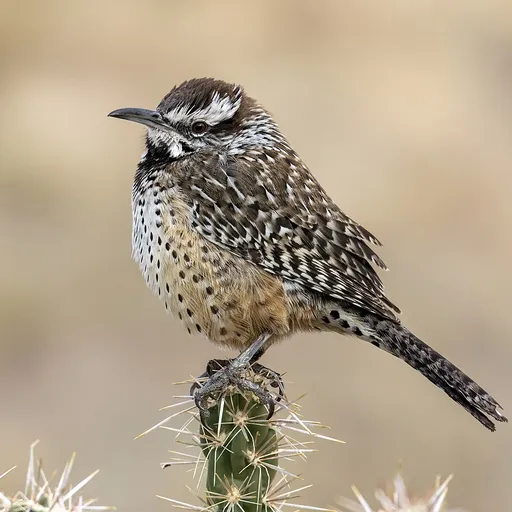
Cactus Wren
Campylorhynchus brunneicapillus
Least Concern
Overview
The cactus wren (Campylorhynchus brunneicapillus) is a species of wren endemic to the deserts of the southwestern United States and northern and central Mexico. It is the state bird of Arizona and holds the distinction of being the largest wren in the United States. This bird is well-adapted to its arid native environment and remains classified as a species of Least Concern by the IUCN Red List.
Identification
- Between 18 and 19 cm long with a thick, heavy, dull black bill that curves slightly downwards and is about the same length as the head.
- Brown plumage featuring black and white spots, a distinctive white eyebrow sweeping to the nape, a white chest with brown or black speckles, and cinnamon-buff underparts and flanks.
- Barred tail with alternating black, white, and brown stripes, and flight feathers barred in black and off-white, showing a white band when flying.
- A loud, raspy song described as resembling a car engine that will not start, often delivered from high vantage points.
Habitat
This species inhabits arid and semi-desert regions, specifically the Sonoran and Chihuahuan Deserts, where it generally requires spiny cacti for nesting. Its range extends across the southwestern United States, including California, Nevada, Utah, Arizona, New Mexico, and Texas, as well as various states in Mexico. The cactus wren is non-migratory, establishing and vigorously defending permanent territories year-round.
Diet
The cactus wren's diet consists chiefly of insects, supplemented by some plant matter, from which it can meet its water needs. As a poor flier, it generally forages for food on the ground, exhibiting somewhat erratic flight patterns when moving between locations.
Did you know?
Cactus wrens have demonstrated remarkable adaptability by learning to coexist with humans, using human materials and structures for nesting, and even learning to extract insects from vehicle radiator grilles. Despite facing threats from habitat loss and introduced species, the population still numbers in the millions.
Sources
- Wikipedia · CC BY-SA 4.0
- Wikidata · CC0 1.0