
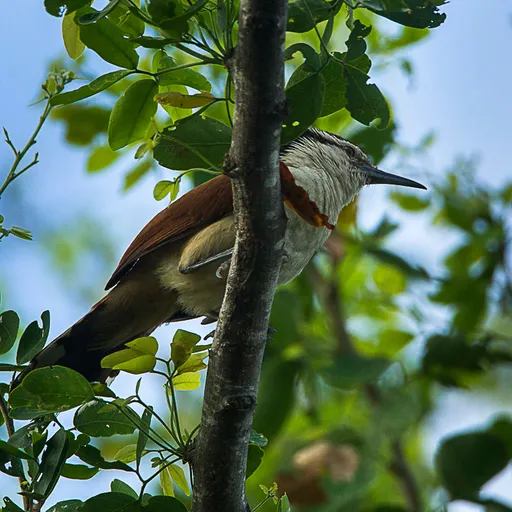
Giant Wren
Campylorhynchus chiapensis
Least Concern
Overview
The giant wren is a species of bird in the family Troglodytidae and is the largest member of its family. It is currently found in Mexico and Guatemala, with recent sightings expanding its known range into northwestern Guatemala. The species is assessed as Least Concern by the IUCN, with a population suspected to be stable.
Identification
- Measures 20 to 22 cm in length and weighs 43.4 to 57 g, making it the largest wren in its family.
- Adults feature a black crown, nape, and shoulders, with a white supercilium separating a black eye-stripe from the white face.
- Upperparts are bright chestnut and the tail is dark chestnut, with white bands near the ends of all tail feathers except the middle pair.
- Underparts range from white on the chin to buff on the belly and vent area.
- Pairs sing in unison with rhythmic hollow phrases, and calls are described as grating and harsh churring.
Habitat
Formerly considered endemic to Chiapas in Mexico, the giant wren is now found in far northwestern Guatemala as well. It inhabits bushland, including heavily modified areas such as farmyards, hedgerows, and fruit orchards. The species occurs only within 50 km of the coast at elevations from sea level to 300 m.
Diet
While the specific diet of the giant wren has not been fully documented, it is probably composed mostly of invertebrates. The bird forages on or near the ground.
Did you know?
Giant wrens build bulky ball-shaped nests with a side entrance, often constructed from straw and placed in acacia trees, and evidence suggests that nest helpers may assist in raising the young.
Sources
- Wikipedia · CC BY-SA 4.0
- Wikidata · CC0 1.0