
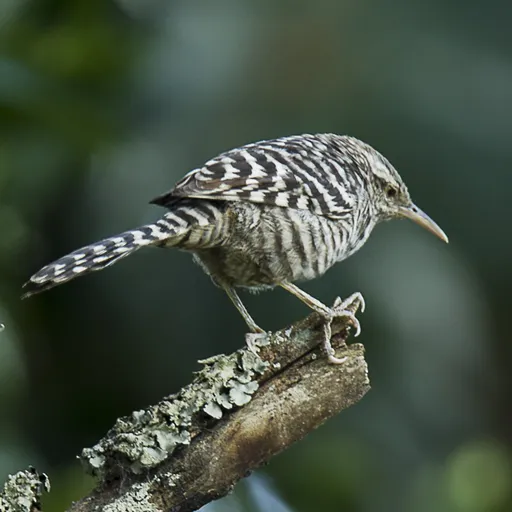
Fasciated Wren
Campylorhynchus fasciatus
Least Concern
Listen
XC242300 · Niels Krabbe · El Oro: Carcabon, Arenillas Ecological Reserve, Ecuador · CC BY-SA 4.0
Overview
The fasciated wren (Campylorhynchus fasciatus) is a species of bird in the family Troglodytidae. It is native to Ecuador and Peru and is currently assessed as Least Concern by the IUCN.
Identification
- Approximately 19 cm (7.5 in) long, with one female recorded at 24.9 g (0.88 oz).
- Nominate subspecies feature a gray crown, grayish supercilium, and dark gray shoulders, back, and rump.
- Shoulders display whitish speckles and the rump has whitish bars, while the tail is barred off-white and blackish brown.
- The chest and belly are whitish with heavy dark gray spots, and the flanks are barred with dark gray.
- Song consists of a series of harsh churring notes interspersed with gurgling notes, often performed as a duet or group song.
Habitat
Primarily inhabits arid and semi-arid landscapes such as thorny scrublands, but also occurs in citrus orchards and other human-modified areas. In Ecuador, it utilizes more humid habitats including deciduous forest. The species is typically found between sea level and 1,500 m (4,920 ft), though it can reach elevations of 2,500 m (8,200 ft).
Diet
The diet is principally invertebrates, with some vegetable matter also included. Foraging is conducted in groups, mostly within bushes and shrubs, though it occasionally forages on the ground.
Did you know?
The species is a cooperative breeder where groups of up to 10 individuals assist a dominant pair. They frequently repurpose old mud nests built by the pale-legged hornero (Furnarius leucopus).
Sources
- Wikipedia · CC BY-SA 4.0
- Wikidata · CC0 1.0