
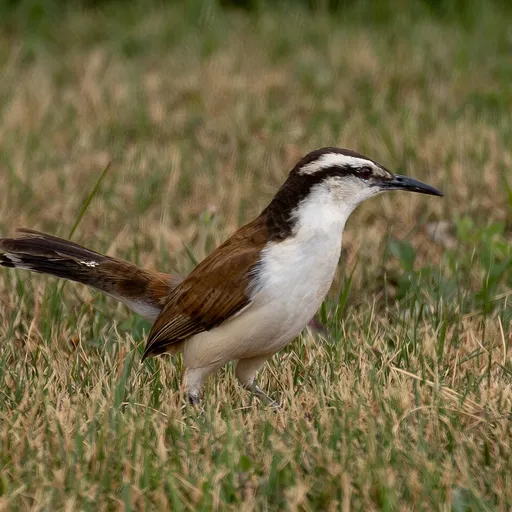
Bicolored Wren
Campylorhynchus griseus
Least Concern
Overview
The Bicolored Wren (Campylorhynchus griseus) is a species of bird in the family Troglodytidae, native to Colombia, Venezuela, Guyana, and Brazil. It is the largest South American wren, second only to the giant wren within its family.
Identification
- Length of 21 to 22 cm and a weight of 37 to 46.5 g, making it the largest wren in South America.
- Nominate adults feature dark chocolate crowns and napes, with paler chocolate upperparts, white underparts, and an off-white supercilium separating a dark brown eye stripe from the crown.
- The tail is dark brown, with white bands near the end of all feathers except the central pair.
- Males produce a song described as a series of multiple loud gurgling notes, while females add a trill to similar vocalisations.
Habitat
The species inhabits areas with scattered trees and bushes, avoiding both dense forests and wide-open spaces. Its range covers parts of Colombia, Venezuela, Guyana, and northern Brazil, with elevations reaching up to 2,100 m in Colombia and 1,600 m in Venezuela.
Diet
Foraging in trees and on the ground, the Bicolored Wren primarily consumes invertebrates but also eats vegetable matter such as berries.
Did you know?
As a cooperative breeder, blood relatives assist the nesting pair by defending the nest and feeding the young. It demonstrates remarkable adaptability by tolerating substantial habitat modification, provided sufficient bushes remain, and can coexist with agricultural practices such as ranching.
Sources
- Wikipedia · CC BY-SA 4.0
- Wikidata · CC0 1.0