
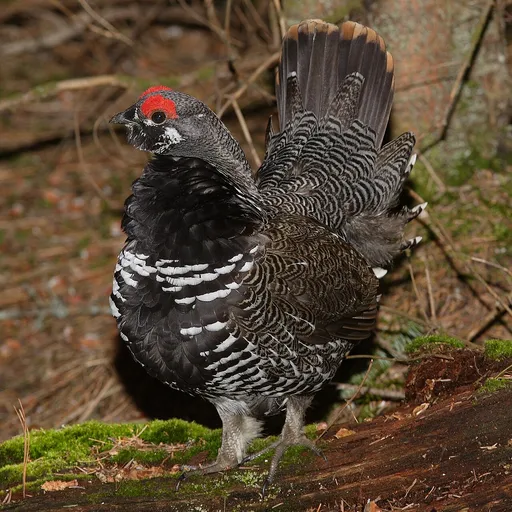
Spruce Grouse
Canachites canadensis
Overview
The spruce grouse, also known as the Canada grouse, spruce hen or fool hen, is a medium-sized grouse closely associated with the coniferous boreal forests of North America. It is the only member of the genus Canachites and is one of the most arboreal grouse species.
Identification
- Males are mainly grey above and black below with white spots along the side, featuring a distinctive red patch of bare skin over the eye known as the 'eyebrow comb'.
- Females are mottled brown or grey with dark and white bars on the underparts and a dark tail with a pale band at the end.
- Juveniles resemble adult females in appearance.
- Territorial males of the franklinii subspecies produce a notable wing-clap display that can be heard from 150 m away.
Habitat
This species is a specialist of the taiga, found throughout Canada and in northern parts of the United States, always associated with conifer-dominated forests such as pine, spruce, or fir. They prefer young successional stands in summer and denser stands in winter.
Diet
The staple winter food is conifer needles, which are clipped directly from the trees, while in summer they forage on the ground for berries, green plants, fungi, and insects. To digest the needles in winter, the caeca and ventriculus increase in size, and the crop can store up to 45 cc of needles for overnight digestion.
Did you know?
In autumn, spruce grouse grow 'snow shoes' in the form of short lateral extensions on their toes, which increase surface area to support the bird on snow and help it grip branches.