
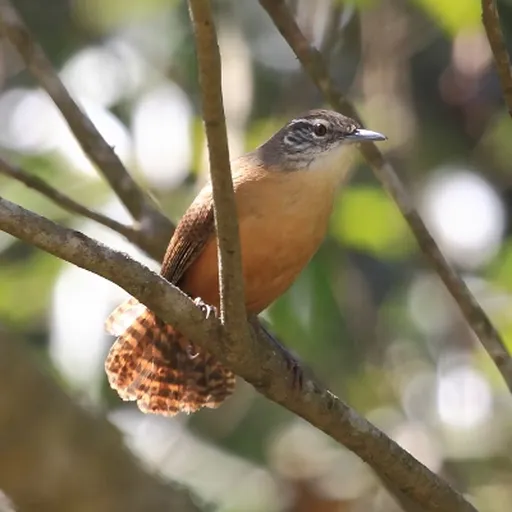
Buff-breasted Wren
Cantorchilus leucotis
Least Concern
Listen
XC1142107 · Rosa Elena Albornoz @rosaelena_naturaleza · Sarare (near Gamelotal), Simón Planas, Lara, Venezuela · CC0 1.0
Overview
The buff-breasted wren (Cantorchilus leucotis) is a small bird found across northern and central South America. It is classified as Least Concern by the IUCN and is believed to be common throughout its extensive range.
Identification
- Adults have rufescent to grayish brown heads, napes, shoulders, tails, and backs, with a heavily barred tail.
- The chest is buffy and the belly is more cinnamon, while the throat and face range from whitish to gray-brown.
- Males weigh 18.5 to 22.8 g, while females are lighter at 16.0 to 19.5 g, though sexes are otherwise similar.
- Both sexes possess large song repertoires, often with a male starting a song and the female completing it.
Habitat
The species primarily inhabits low to medium height vegetation, including secondary forest, regenerating clearings, and mangrove forests. In Amazonia, it is often found on the borders of várzea forest and older river islands, while in Venezuela it is restricted to gallery forest along waterways. Its range covers the Amazon Basin, the Guianas, and parts of Venezuela, Colombia, and eastern Panama.
Diet
Foraging in pairs or family groups, the buff-breasted wren hunts by hopping or making short flights through thick vegetation. They typically forage between 1 and 6 m above ground, though they may go as high as 18 m or down to the forest floor. Their diet consists of insects, spiders, and other small arthropods, which they find by gleaning and probing.
Did you know?
The species constructs both breeding and 'dormitory' nests, the latter being used specifically for roosting. Juveniles may assist in the construction of these dormitory nests, which are generally flimsier than their breeding counterparts.
Sources
- Wikipedia · CC BY-SA 4.0
- Wikidata · CC0 1.0