
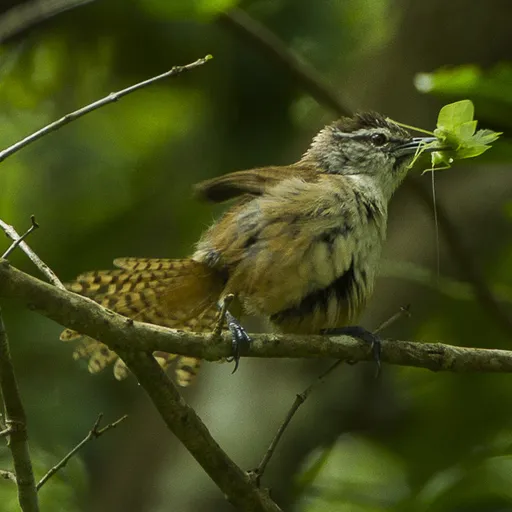
Cabanis's Wren
Cantorchilus modestus
Least Concern
Listen
XC961544 · MANUEL DE JESUS HERNANDEZ ANCHEITA · Chiapas, Palenque Ruins, Mexico · CC0 1.0
Overview
Cabanis's wren (Cantorchilus modestus) is a small passerine bird in the family Troglodytidae, assessed as Least Concern by the IUCN. It is common to abundant in its range and thrives in human-modified landscapes, having been formerly known as part of the plain wren complex before being split in 2016 based on vocal and genetic differences.
Identification
- 12.5 to 14 cm (4.9 to 5.5 in) in length, with males weighing 17.8–19.1 g and females 16.0–16.6 g.
- Dark gray-brown crown, rufous-brown back, orange-rufous rump, and rufescent brown tail with narrow darker bars.
- White supercilium, gray-brown post-ocular stripe, mottled gray-brown and gray-white cheeks, white throat, pale grayish buff breast, and buffy white belly contrasting with orange-buff flanks.
- Song consists of a loud motif of 3–4 clear whistles; calls include a harsh 'chur' and a rippling, tinkling 'chi-cho-chi'.
Habitat
Found from the Mexican states of Oaxaca and Chiapas south through Belize, Guatemala, El Salvador, Honduras, and Nicaragua to the Pacific side of central Costa Rica. It inhabits both dry and humid areas across a wide range of surroundings, including forest edges, second growth, and gardens. Elevation ranges from sea level to approximately 2,000 m (6,600 ft).
Diet
The diet is composed mostly of insects and spiders. Foraging typically occurs in pairs within low, dense vegetation, although the bird will occasionally hunt higher in trees.
Did you know?
Its nest is roughly football-shaped, constructed of grass and other vegetable fibers lined with softer material, and placed in dense vegetation within 3 m (9.8 ft) of the ground. The usual clutch size is two, though clutches of three eggs are known.
Sources
- Wikipedia · CC BY-SA 4.0
- Wikidata · CC0 1.0