
Bay Wren
Cantorchilus nigricapillus
Least Concern
Listen
XC957560 · Beth Cottam · Finca Tres Equis - Farm and Forest (near Tres Equis), Turrialba, Cartago Province, Costa Rica · CC0 1.0
Overview
The bay wren (Cantorchilus nigricapillus) is a small bird in the family Troglodytidae. It is native to southern Central America and northwestern South America, with seven recognised subspecies spanning from Nicaragua to Ecuador.
Identification
- Length ranges from 12.6 to 15.6 cm (5.0 to 6.1 in).
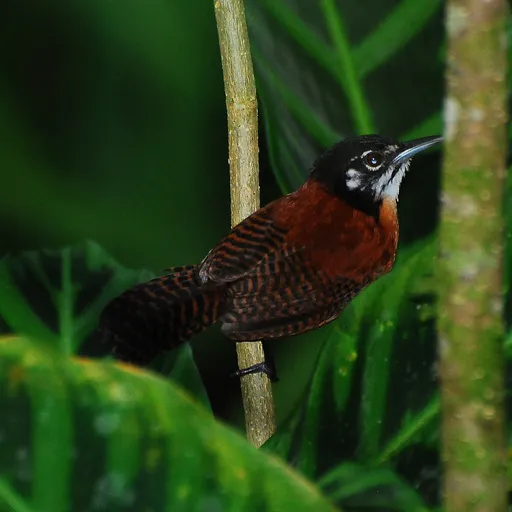
- Adults of the nominate subspecies feature a black face with a narrow white supercilium, a partial eyering, and a white patch at the back of the cheek.
- Upperparts include a black crown and nape, with the rest being rich chestnut; the tail is rich brown with bold black bars.
- Underparts are white on the throat and breast, transitioning to rufous brown on the lower belly and flanks, crossed by black bars.
Habitat
The range spans from Nicaragua to Ecuador, closely tied to water over most of its area, though drier in Nicaragua. It inhabits dense, fairly low vegetation such as thickets along watercourses, overgrown clearings, roadsides, and the understory of secondary forest, or forest interiors with sufficient undergrowth.
Diet
The diet consists entirely of invertebrates. The bird forages by gleaning from foliage and branches and by probing hanging vegetation and tangles of vines.
Did you know?
Although it prefers areas near water, the species seems to tolerate and possibly benefit from certain forms of human habitat modification, provided the vegetation structure remains intact.
Sources
- Wikipedia · CC BY-SA 4.0
- Wikidata · CC0 1.0