
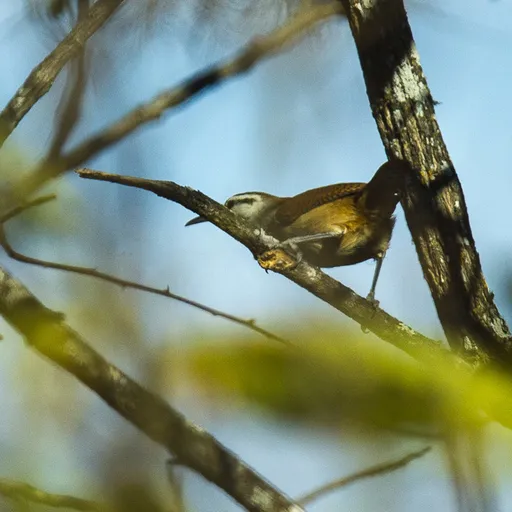
Superciliated Wren
Cantorchilus superciliaris
Least Concern
Listen
XC242321 · Niels Krabbe · El Oro: Carcabon, Arenillas Ecological Reserve, Ecuador · CC BY-SA 4.0
Overview
The superciliated wren (Cantorchilus superciliaris) is a small bird in the family Troglodytidae. It is classified as Least Concern by the IUCN and is found in parts of western Ecuador and central Peru.
Identification
- Measures 14.5 cm in length with a dark greyish brown crown and rufous-brown shoulders and back that become redder on the rump.
- Features a prominent white supercilium, a dark brown stripe through the eye, and buffy-white cheeks.
- Adults of the nominate subspecies have a reddish-brown tail with black bars, while C. s. baroni displays a more tawny lower back and rump.
- Both sexes sing a series of short repeated phrases of two or three notes, occasionally with a trill added.
Habitat
Primarily inhabits dry woodland, scrub, and brushland, though it also occurs in more humid woodland. It is found in western Ecuador and west-central Peru, typically ranging from sea level up to 1,500 m, but occasionally as high as 1,850 m.
Diet
Forages in vegetation on and near the ground, usually in pairs. Its primary food appears to be insects.
Did you know?
Pairs construct several flimsy, flask-shaped nests but use only one for breeding, with the chosen nest typically lined with soft material and placed 1.6 to 3.2 m above the ground. These nests are frequently parasitised by shiny cowbirds.
Sources
- Wikipedia · CC BY-SA 4.0
- Wikidata · CC0 1.0