
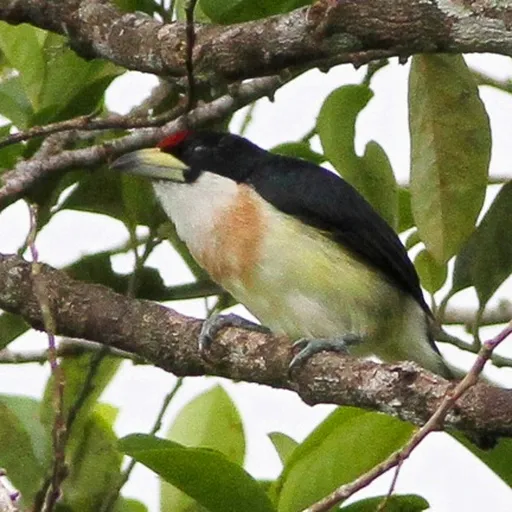
White-mantled Barbet
Capito hypoleucus
Least Concern
Overview
The white-mantled barbet (Capito hypoleucus) is a large New World barbet endemic to Colombia. It is found in tropical moist montane forests, pastureland, and plantations, though its population is threatened by habitat loss.
Identification
- Approximately 19 cm in length with black upperparts and narrow, often obscured, pale lines on the nape and scapulars.
- Red forehead and crown contrasting with white underparts that show a slight yellowish wash and a cinnamon flush on the breast.
- Large, chunky yellowish bill, red eyes, and greenish-grey legs; females possess a distinct black spot at the base of the lower mandible.
Habitat
Endemic to the Middle Magdalena Valley of Colombia, occupying altitudes between 200 and 1,800 m. It inhabits humid forests on montane slopes as well as mosaic landscapes of pastures, secondary forest, and plantations mixed with fruiting trees.
Diet
Forages in pairs or family groups and may join mixed-species feeding flocks, typically remaining in the forest canopy. It descends to open areas to feed on fruiting trees such as mango and Cecropia.
Did you know?
The species name is derived from the Latin capito meaning 'big-headed', and the Ancient Greek hupo and leukos meaning 'beneath' and 'white'. This large bird was first described in 1897 based on a sample collected by Edgar Pratt in the Antioquia Department.
Sources
- Wikipedia · CC BY-SA 4.0
- Wikidata · CC0 1.0