
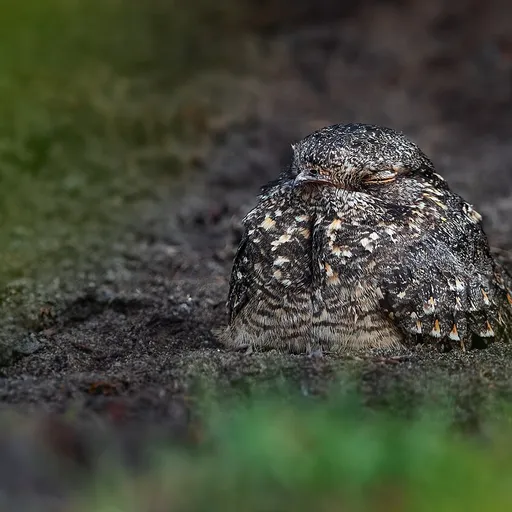
Savanna Nightjar
Caprimulgus affinis
Least Concern
Listen
XC362162 · HK Leung · Hong Kong, Yuen Long District, New Territories, China · CC BY-SA 4.0
Overview
The savanna nightjar, also known as the allied or Franklin's nightjar, is a nocturnal species of nightjar found across South and Southeast Asia. It is currently listed as Least Concern on the IUCN Red List due to its large range and stable population trend.
Identification
- Measures 20–26 cm in length with a body weight of 54–110 g, ranging from small to medium-large.
- Features long pointed wings, small legs and feet, and a wide bill surrounded by facial feathers called rictal bristles.
- Displays vermiculated grey-brown plumage that provides excellent camouflage, making visual identification difficult.
- Males possess distinct white patches on the throat, tail and wings, whereas females have subtle throat patches, a red tint to their feathers, and no white tail patches.
- Distinguished from similar species by its characteristic "chwip" call, which is used for territorial marking and attracting mates.
Habitat
Widespread across northern Pakistan, south China, India, Indonesia and Taiwan, the species occupies low-land open grasslands, sugar cane plantations, wheat fields and rocky soils near rivers. With urban development, populations have adapted to nesting on the flat roofs of tall buildings to avoid predators. Migration patterns vary by subspecies, with some being non-migratory and others, such as C. a. monticolus, migrating to the Punjab plains for summer breeding.
Diet
As a nocturnal insectivore, the savanna nightjar forages by sallying to capture prey in flight and near-darkness using its large eyes and massive gape. Moths constitute 80–85% of its diet, supplemented by beetles, ants, grasshoppers, crickets, wasps and bees.
Did you know?
In urban Taiwan, the species' booming call can reach up to 90 decibels, causing such sleep disruption and nightmares among residents that citizens have resorted to using firecrackers and flashlights to drive the birds away.
Sources
- Wikipedia · CC BY-SA 4.0
- Wikidata · CC0 1.0