
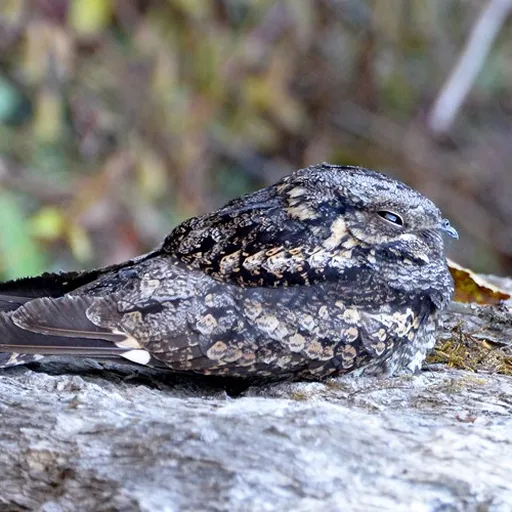
Grey Nightjar
Caprimulgus jotaka
Least Concern
Overview
The grey nightjar (Caprimulgus jotaka) is a medium-sized species of nightjar found across East Asia, ranging from southeastern Russia to northern Indochina and western Himalayas. It is largely migratory, wintering in Indonesia, though it remains resident in warmer southern parts of its breeding range.
Identification
- Medium-sized body with a large head, large eyes, long tail, weak bill, and short legs.
- Mottled plumage featuring intricate grayish-white and dark brown vermiculations on the crown, with a prominent central black stripe.
- Dark brown underparts with pale brownish-yellow patches densely covered in dark brown horizontal stripes.
- Distinctive song consisting of hollow 'byuck' notes lasting 2–4 seconds, often compared to the firing of a cartoon laser gun.
Habitat
The species breeds and forages in early successional habitats surrounded by forests, including broadleaf and mixed broadleaf-coniferous woodlands, as well as shrublands and cliffs up to 3300 m in altitude. Its range spans from South Asia and southeastern Russia east to Japan, with vagrants occasionally recorded as far north as Alaska.
Diet
As an insectivore, the grey nightjar feeds primarily on flying insects such as beetles, moths, and flying ants. Foraging takes place at night, particularly at dusk, with the bird hovering or gliding silently to capture prey mid-air.
Did you know?
The species was formally described in 1845 with a scientific name derived from the Japanese term 'yo taka', which literally translates to 'night hawk'. Its eggs are laid directly on the ground without a constructed nest, often placed on rocks, in grass, or within dense vegetation.
Sources
- Wikipedia · CC BY-SA 4.0
- Wikidata · CC0 1.0