
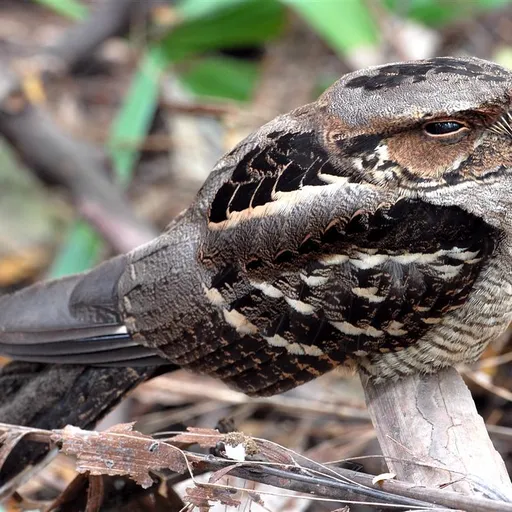
Large-tailed Nightjar
Caprimulgus macrurus
Least Concern
Listen
XC864330 · Untung Sarmawi · Baluran National Park, East Java, Indonesia · CC0 1.0
Overview
The large-tailed nightjar (Caprimulgus macrurus) is a species of nightjar characterised by its distinctive long, broad tail and cryptic plumage. It is classified as Least Concern on the IUCN Red List.
Identification
- Approximately 31.5 to 33 cm in length with cryptic colouration providing effective camouflage.
- Males possess a pale crown with a dark median stripe, a prominent row of black scapular feathers bordered by buff or whitish-buff fringes, a white throat patch, and a broad brown tail marked with uneven dark bars.
- Females display paler, greyer plumage with smaller buff-coloured wing patches and less vibrant tail patches than males.
- Large white patches on the primaries and outer tail feathers are visible in flight.
Habitat
Found along the southern Himalayan foothills, eastern South Asia, Southeast Asia, and northern Australia, this species inhabits subtropical or tropical moist lowland and montane forests, as well as mangrove forests. It also commonly occurs in secondary forests, forest edges, plantations, wooded parks, and agricultural landscapes.
Diet
Large-tailed nightjars are aerial insectivores that primarily consume beetles, moths, and other flying insects while in flight. Occasionally, they may be observed walking and pecking at the ground to prey on terrestrial ants, potentially in response to low abundance of flying insects.
Did you know?
Females do not build a nest, instead laying one or two eggs in a shallow depression of leaf litter on the ground. Chicks may be moved from the nest site one or two days after hatching and move every night, sometimes separating to avoid detection by predators.
Sources
- Wikipedia · CC BY-SA 4.0
- Wikidata · CC0 1.0