
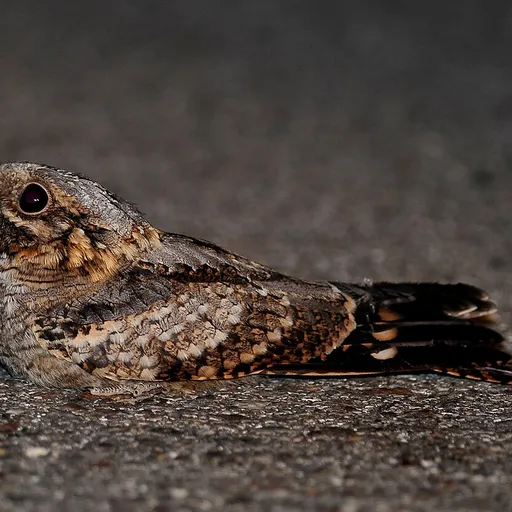
Red-necked Nightjar
Caprimulgus ruficollis
Near Threatened
Listen
XC431983 · Joost van Bruggen · El Condado (near Almonte), Huelva, Andalucía, Spain · CC BY-SA 4.0
Overview
The red-necked nightjar is the largest of the nightjars occurring in Europe. It breeds in Iberia and North Africa, and winters in tropical West Africa. The species is currently classified as Near Threatened on the IUCN Red List.
Identification
- Length of 32 cm and a wingspan of 64 cm, making it larger and longer-tailed than the more widespread European nightjar.
- Lichen-grey plumage barred and streaked with buff, chestnut, and black, featuring a distinctive rufous neck-collar.
- White wing spots, tail sides, and throat are present on both sexes.
- The call consists of a repetitive mechanical 'kyok-kyok-kyok' that rises and falls as the bird turns its head, accompanied by a sharp cracking sound produced by clapping the wings together over the back.
Habitat
This crepuscular bird frequents open sandy heaths that contain trees or bushes. Its range includes breeding grounds in Iberia and North Africa, with wintering grounds in tropical West Africa.
Diet
The red-necked nightjar feeds on crepuscular insects, such as moths. It flies at dusk with an easy, silent moth-like flight to forage for these prey items.
Did you know?
The common name 'nightjar' derives from an old myth that the birds suck milk from goats, a belief reflected in the genus name Caprimulgus, which comes from the Latin words for 'nanny goat' and 'to milk'.
Sources
- Wikipedia · CC BY-SA 4.0
- Wikidata · CC0 1.0