
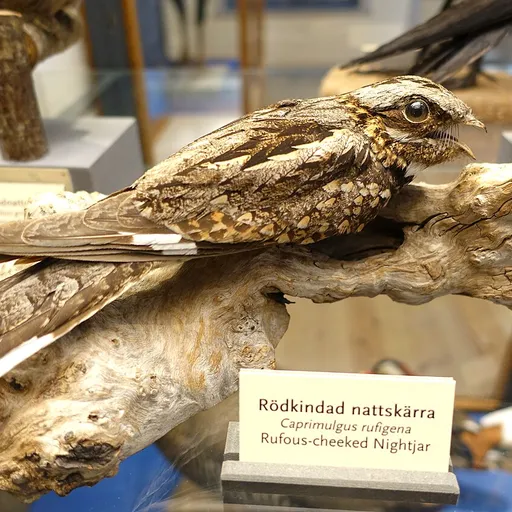
Rufous-cheeked Nightjar
Caprimulgus rufigena
Least Concern
Overview
The rufous-cheeked nightjar (Caprimulgus rufigena) is a nocturnal species of nightjar found across various parts of Africa. It is an intra-African migrant that breeds in the south of its range, while spending the non-breeding season in eastern and central regions, though it remains present in Southern Africa year-round. The species is classified as Least Concern on the IUCN Red List.
Identification
- Size: 23–24 cm in length with males weighing 48–65 g and females 46–66 g.
- Plumage: Dark brown body with rufous-coloured spots and a distinct rufous collar, providing excellent camouflage against the ground.
- Bill and Legs: Features a short, slightly curved black beak typical of nightjars.
- Markings: Males have white marks on the primaries and tail corners, whereas these are buff in females; juveniles display counter-shading.
- Song: Vocalisations include an upbeat 'Q! Q! Q! Q!' or harsh 'oar! oar! oar!' flight call, and territorial churring that can last for minutes.
Habitat
This species inhabits wooded areas such as miombo woodland, wooded savanna, and clearings, as well as open semi-arid acacia shrubland and semi-deserts. It avoids rivers, lakes, and moist areas, preferring drier environments for breeding and nesting, often choosing bare or recently burnt ground. Its range includes Southern Africa year-round, with non-breeding grounds extending to eastern Nigeria, Cameroon, southern Chad, Sudan, and parts of the Republic of the Congo and D.R.C.
Diet
The rufous-cheeked nightjar feeds primarily on flying insects such as beetles, moths, and grasshoppers, hunting mainly at dusk and early night but occasionally at dawn or in moonlight. It locates prey using large eyes adapted for low light, perching low to the ground to leap and snatch insects before returning to its spot, or flying to search for them. It frequently hunts by roads where insects are attracted to street lights and can drink water by hovering over waterholes.
Did you know?
The rufous-cheeked nightjar does not build a traditional nest but lays its eggs in small grooves on the ground, relying on its plumage for camouflage to conceal them from predators. To locate these perfectly hidden nests, the parents use quartzite blocks as landmarks to guide them back to the site.
Sources
- Wikipedia · CC BY-SA 4.0
- Wikidata · CC0 1.0