
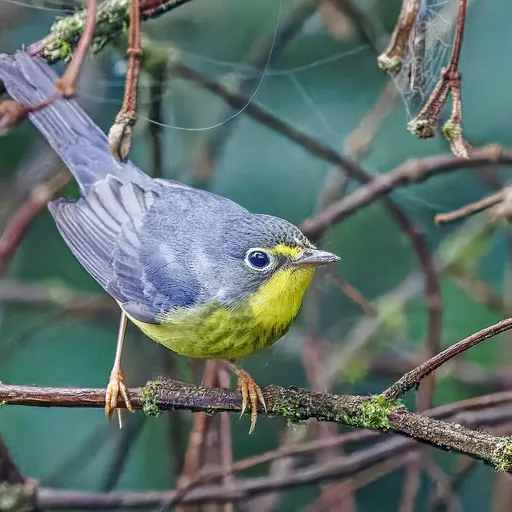
Canada Warbler
Cardellina canadensis
Least Concern
Listen
XC250583 · Niels Krabbe · Napo: Napo Galeras, Ecuador · CC BY-SA 4.0
Overview
The Canada warbler (Cardellina canadensis) is a small boreal songbird belonging to the New World warbler family. It is also known as the 'necklaced warbler' due to the distinct dark streaks across its chest. The species is classified as Least Concern on the IUCN Red List.
Identification
- Adults measure 12–15 cm in length and feature yellow chests, throats, and bellies contrasted with dark grey backs.
- The most striking facial feature is prominent white eyerings, often described as 'spectacles', accompanied by a yellow line extending from the eye towards the beak.
- The bird lacks wingbars or tail spots, though the underside of the tail is white.
- Males have a darker, more conspicuous chest band and a longer tail than females, while immature specimens appear duller with less pronounced facial markings.
Habitat
This species inhabits moist thickets, including riparian areas, brushy ravines, and forest bogs across a variety of forest types. In its breeding range, it frequents aspen forests in the northwestern regions, forested wetlands in the centre, and montane rhododendron thickets in the south. During winter, it prefers mid- and upper-elevation habitats in northern South America.
Diet
The Canada warbler primarily feeds on insects such as beetles, mosquitoes, flies, moths, and smooth caterpillars, supplemented by spiders, snails, worms, and occasional fruit. It forages by flushing insects from foliage to catch them on the wing, a tactic it uses more frequently than other warblers, and also searches the ground among fallen leaves.
Did you know?
Males possess two performance-encoded song types: Mode I, consisting of stereotyped songs sung slowly, and Mode II, featuring variable songs with an irregular rhythm and chirping between phrases. Most phrases are shared between these two modes, a characteristic unique among parulids, which typically keep their repertoires in two distinct parts.
Sources
- Wikipedia · CC BY-SA 4.0
- Wikidata · CC0 1.0