
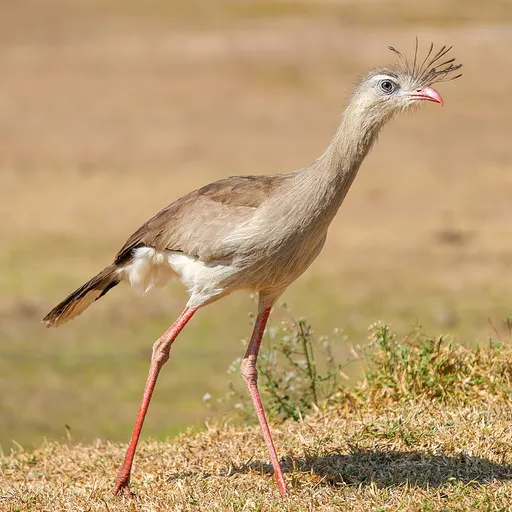
Red-legged Seriema
Cariama cristata
Least Concern
Overview
The red-legged seriema (Cariama cristata), also known as the crested cariama, is a mostly predatory terrestrial bird in the family Cariamidae. It is a large, long-legged species that inhabits grasslands and semi-open habitats across South America, currently classified as Least Concern by the IUCN.
Identification
- A large bird, 75 to 90 cm long, with long, salmon-coloured legs, a reddish beak, and yellow eyes.
- Greyish-brown plumage finely barred with dark brown and black, featuring a pale brown head and white belly.
- A distinctive fan-shaped crest of soft feathers emerges from the base of the bill, and the long outer tail has a subterminal black band with a white tip.
- The song is described as a cross between the bark of a young dog and the clucking of turkeys, audible from several kilometres away.
Habitat
Found in central and eastern Brazil, Paraguay, eastern and southeastern Bolivia, Uruguay, and northeastern Argentina, typically at elevations up to 2,000 m. The species strongly prefers grassland habitats, such as savannas, ranchlands, and semi-arid woodlands, and is typical of the Caatinga, Cerrado, and Chaco ecosystems. It avoids wetlands and crop fields, favouring semi-open and fairly dry areas.
Diet
As an omnivore, it feeds on arthropods, insect larvae, and various small vertebrates like lizards, amphibians, snakes, and rodents, occasionally consuming crop grains, wild fruits, and the eggs or chicks of other birds. It forages on the ground or in low vegetation, often using a unique technique of picking up prey and repeatedly throwing it at the ground until it is stunned or dead before dismembering it.
Did you know?
Farmer often employ red-legged seriemas as guard animals to protect poultry from predators and even human intruders. In a rare documented case of parental infanticide and cannibalism, an adult was observed killing a third nestling to serve as reserve food for its other two chicks during times of stress.
Sources
- Wikipedia · CC BY-SA 4.0
- Wikidata · CC0 1.0