
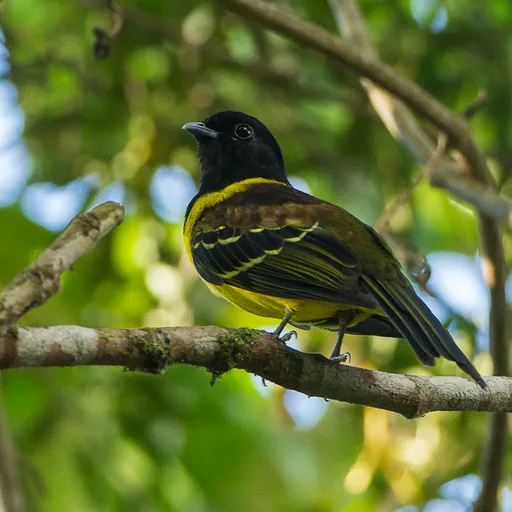
Hooded Berryeater
Carpornis cucullata
Least Concern
Overview
The hooded berryeater is a species of bird in the family Cotingidae, endemic to Brazil. It is a year-round resident that is currently classified as Least Concern on the IUCN Red List, although its population is believed to be decreasing.
Identification
- Adults are 22.5 to 25 cm long, with males featuring an entirely black head, neck, and upper breast distinguished by a thin yellow collar.
- Males have chestnut-tinged brown backs, dull greenish olive rumps, and yellow underparts, while females are duller with an olive wash and faintly barred breasts.
- Both sexes possess dark brown irises and blue to violet-blue bills, legs, and feet.
- The song is described as a "soft, mellow, wrat? what-now".
Habitat
This species occurs in Brazil, favouring primary forest and showing sensitivity to fragmentation, particularly in smaller forest patches. It is considered a key species in maintaining ecological networks within Atlantic Forests.
Diet
The hooded berryeater feeds primarily on fruit, supplemented by small insects. It usually forages singly in the forest's mid-story to subcanopy.
Did you know?
The breeding season appears to include September and October, but nothing else is known about the species' breeding biology.
Sources
- Wikipedia · CC BY-SA 4.0
- Wikidata · CC0 1.0