
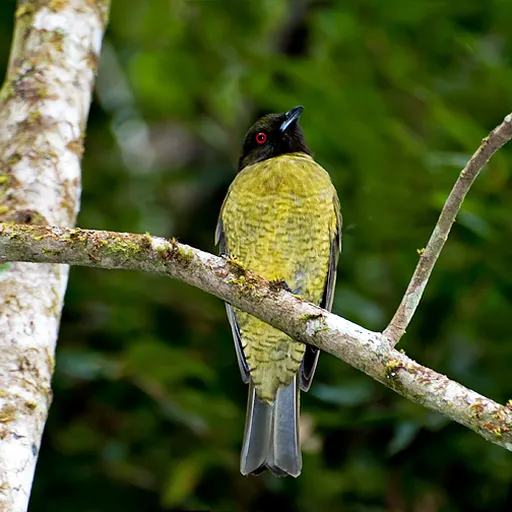
Black-headed Berryeater
Carpornis melanocephala
Near Threatened
Overview
The black-headed berryeater is a Near Threatened bird endemic to Brazil and a member of the cotinga family. With an estimated population of 2,500 to 10,000 mature individuals, it is considered rare to uncommon and is largely dependent on protected areas due to its low tolerance of converted habitats.
Identification
- Measures 20 to 21 cm in length and weighs between 63 to 67 g.
- Adult males feature an entirely black head, neck, and throat accented by a thin yellow collar, while females have an olive wash on the head.
- Displays dull olive-green upperparts, olive-yellow underparts with fine dark bars, a plainer yellow lower belly, and a blackish bill with a plumbeous base.
- Song is described as a high, gliding-down, indignant-sounding 'njauow'.
Habitat
Inhabits humid forest and occasionally restinga in southeastern Brazil, ranging from Alagoas to northeastern Paraná. Elevation typically spans from sea level to 500 m, with local occurrences up to 700 m.
Diet
Feeds primarily on fruit and forages in the mid-story to subcanopy of the forest. There is a single recorded instance of it consuming a stick insect.
Did you know?
The species was originally described under a different name and taxonomic lineage before being reclassified into its current genus, Carpornis, in 1970. Its sole known nest was a shallow cup of dry leaves and stems that closely resembled a pile of leaf litter, holding a single pale, horn-colored egg.
Sources
- Wikipedia · CC BY-SA 4.0
- Wikidata · CC0 1.0