
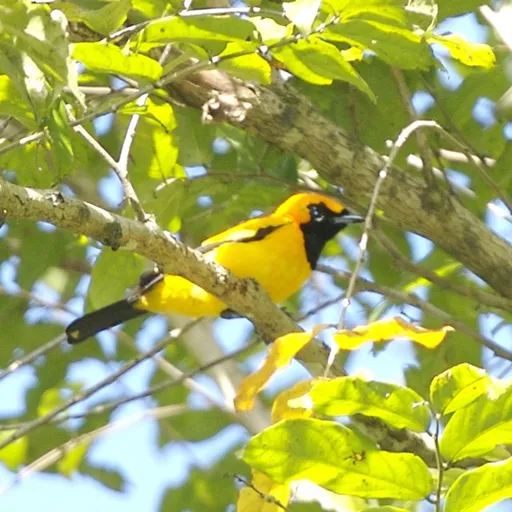
Golden Monarch
Carterornis chrysomela
Least Concern
Overview
The golden monarch (Carterornis chrysomela) is a passerine bird in the family Monarchidae, found across New Guinea and its surrounding island groups. It is a member of the monarch flycatchers and displays marked sexual dimorphism.
Identification
- Size: 12.5 to 14 cm (4.9 to 5.5 in) in length.
- Plumage: Males are bright golden with sharply delineated black cheeks, throat, primaries, and tail; females are olive-greenish with more yellowish underparts.
- Markings: Both sexes bear a distinctive 'teardrop' pattern of white feathers below the eye.
- Bill and Eyes: Males have a pale blue and black bill with dark brown irises; females possess a black bill.
Habitat
Native to New Guinea, the Aru Islands, the D'Entrecasteaux Islands, and the Bismarck Archipelago, but absent from New Britain. It inhabits subtropical or tropical moist lowland and montane forests, typically up to 700 m elevation, or 1400 m in New Ireland, remaining mainly in the canopy.
Diet
Insectivorous, the golden monarch forages for insects and is often found in mixed-species foraging flocks alongside the yellow-bellied gerygone and Wallace's fairywren.
Did you know?
Originally described by the French naturalist Prosper Garnot in 1827, the golden monarch has been classified in the 'Core corvine' group, which includes crows, ravens, and shrikes, rather than being closely related to Old World flycatchers.
Sources
- Wikipedia · CC BY-SA 4.0
- Wikidata · CC0 1.0