
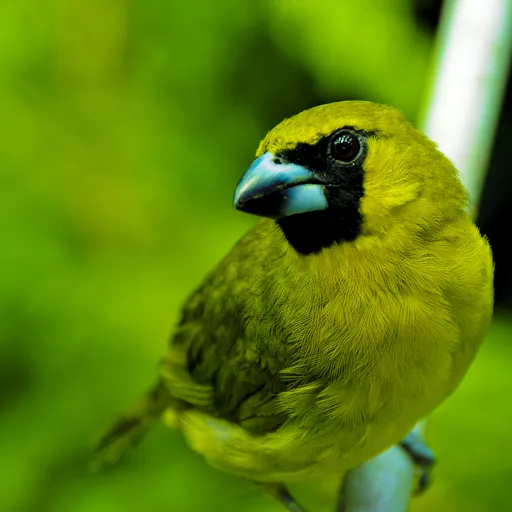
Yellow-green Grosbeak
Caryothraustes canadensis
Least Concern
Overview
The yellow-green grosbeak is a species of bird in the family Cardinalidae, found across parts of South and Central America. It is currently classified as Least Concern by the IUCN, with an estimated population of at least five million mature individuals.
Identification
- Size: 17 to 18.5 cm long, weighing 31 to 36 g.
- Plumage: Bright yellow underparts with a slight greenish tinge on the breast and flanks; yellowish green upperparts; black lores, cheeks, and throat in the nominate subspecies.
- Features: Heavy black bill with a bluish gray base; gray legs and feet; brown iris.
- Song: A lively but monotonous "chap, chap cheeweep" at dawn; foraging calls include a loud, buzzy rattle.
Habitat
It inhabits the interior and edges of humid evergreen forest in tropical and lower subtropical zones. Its range spans from Panama to Brazil, with four distinct subspecies found in disjunct populations across these regions.
Diet
It feeds on fruit and insects, typically foraging in flocks of twelve or more that often join mixed-species feeding groups. Foraging occurs from the mid-level to the canopy of the forest.
Did you know?
The species' scientific name, canadensis, was coined by Linnaeus who mistakenly believed the bird occurred in Canada, whereas it was actually described from Cayenne in French Guiana.
Sources
- Wikipedia · CC BY-SA 4.0
- Wikidata · CC0 1.0