
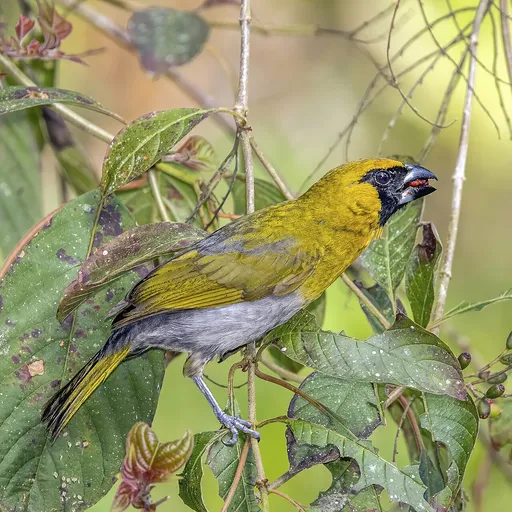
Black-faced Grosbeak
Caryothraustes poliogaster
Least Concern
Overview
The black-faced grosbeak (Caryothraustes poliogaster) is a species of passerine bird in the family Cardinalidae. It is found across Mexico and Central America, extending as far south as Panama.
Identification
- Measures 14 to 22 cm in length with an average weight of 35 g; adults of the nominate subspecies have a black face and throat, with a yellow forecrown and olive-tinged yellow head.
- Upper parts include yellowish olive-green wings and back, with slate gray scapulars and rump, while the breast is yellow and the belly is grayish white.
- Possesses a thick, hooked bill with a black maxilla and gray or blue-gray mandible, along with bluish gray legs and feet.
- Vocalisations are loud and arresting, including buzzy 'zzzrt' calls and a short, sweet warble of sharp squeaky whistles.
Habitat
Primarily inhabits the interior and edges of evergreen forest in tropical and lower subtropical zones, though it also occurs in secondary forest, pine savanna edges, and gardens. Its distribution is disjunct across the Caribbean side of Mexico and Central America, with a range from central Veracruz to western Panama.
Diet
Feeds on a wide variety of fruits, including figs and Cecropia, as well as insects such as adults and larvae. It gleans prey from leaves and branches and takes some insects on the wing, foraging mostly in the forest canopy but sometimes in lower clearings.
Did you know?
The bird is assessed as Least Concern despite a decreasing population, largely due to its flexibility regarding habitat types and tolerance of edge and secondary forest, though studies note it often fails to inhabit disturbed landscapes even when adjacent to forests.
Sources
- Wikipedia · CC BY-SA 4.0
- Wikidata · CC0 1.0