
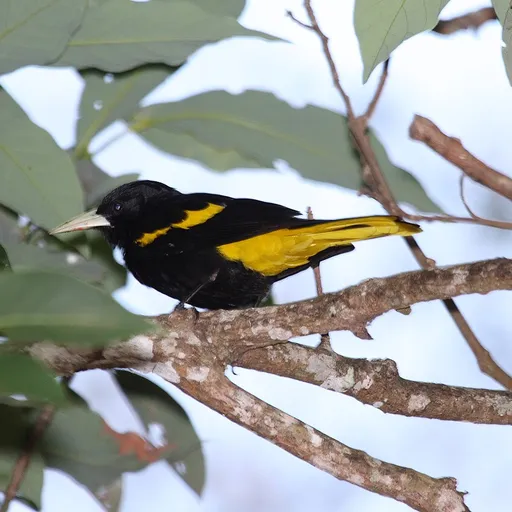
Mexican Cacique
Cassiculus melanicterus
Least Concern
Listen
XC799007 · Ana Rebeca Martinez Martinez · San Cristóbal Honduras, San Jerónimo Coatlán, Oaxaca, Mexico · CC0 1.0
Overview
The Mexican cacique, also known as the yellow-winged cacique (Cassiculus melanicterus), is a species of bird in the family Icteridae. It is the only member of its genus and is found in parts of Central America and Mexico.
Identification
- Adult males are glossy black with a long crest, featuring yellow lower back, uppertail coverts, and wing coverts, while females are duller slaty black with a shorter crest and olive-edged yellow tail feathers.
- Males average 32 cm in length and weigh about 96 g, whereas females are smaller at 28 cm and 70 g.
- Both sexes possess a dark brown iris, an ivory-colored bill with variable darker tinges, and dark gray legs and feet.
- The song is variable, commonly described as "krrow-krrow-kshárá-chee", accompanied by calls that include harsh chatters, bell-like screams, and clear whistles.
Habitat
Found in El Salvador, Guatemala, and along the Pacific lowlands of Mexico from central Sonora to western Chiapas, the species inhabits clearings and edges of dry to moderately humid deciduous forest, thorn scrub, and grassy areas with large trees. In El Salvador, it primarily occurs in coastal mangroves and gallery forest. Its altitudinal range is from sea level to 1,500 m, though it reaches only about 200 m in Guatemala and El Salvador.
Diet
The bird feeds primarily on insects and other invertebrates, with lesser amounts of fruit and nectar, and occasionally preys on small vertebrates. It forages in small flocks mostly from the forest's mid-level to the canopy and sometimes joins mixed-species feeding flocks.
Did you know?
Although typically suspended from tree branches, nests have been noted hanging from utility wires, and many rural nests are located near houses.
Sources
- Wikipedia · CC BY-SA 4.0
- Wikidata · CC0 1.0