
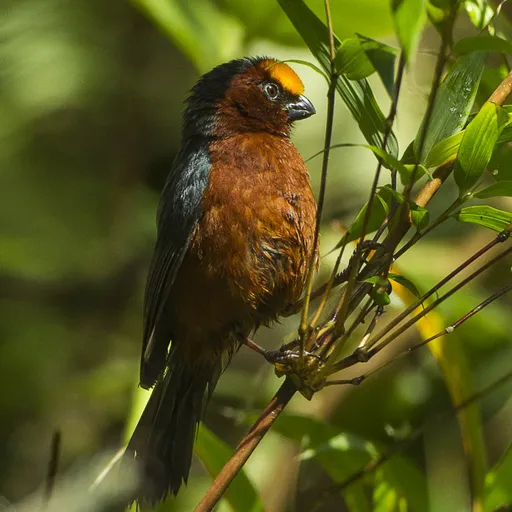
Plushcap
Catamblyrhynchus diadema
Least Concern
Listen
XC242330 · Niels Krabbe · Pichincha: Calacalí-Nanegalito road, Ecuador · CC BY-SA 4.0
Overview
The plushcap (Catamblyrhynchus diadema) is a distinctive Neotropical passerine and the sole member of the genus Catamblyrhynchus, currently classified within the tanager family Thraupidae. It is the only member of its genus and is known for its unique appearance and specialized behavior.
Identification
- Plumage: Chestnut body with a bright golden-yellow forecrown composed of stiff, dense feathers that appear plush.
- Size: Approximately 14 cm (5.5 in) long, with males averaging 14.9 g and females 13.4 g.
- Bill: Broad and black.
- Markings: Black feathers extend from the nape to the wings; juveniles are duller versions of adults.
- Vocalization: Usually quiet, but when vocalising, it produces a long series of chirps and twitters.
Habitat
Plushcaps inhabit humid montane forests and secondary woodlands at high elevations, typically between 1,800 and 3,500 m, and are always found in close association with Chusquea bamboo. Their range extends from northern Venezuela south to extreme northwestern Argentina, covering the coastal mountains of Venezuela and the Andes of Colombia, Ecuador, Peru, and Bolivia.
Diet
The diet consists of small insects, berries, and small plant matter. Foraging is performed in small groups or mixed-species flocks by probing, prying open, or running the bill along bamboo stems and leaf nodes, often while hanging upside down.
Did you know?
The stiff, short feathers of the forecrown are hypothesised to be more resistant to moisture and wear than typical feathers, an adaptation likely necessary for its specialized feeding mode of probing into dense bamboo whorls.
Sources
- Wikipedia · CC BY-SA 4.0
- Wikidata · CC0 1.0