
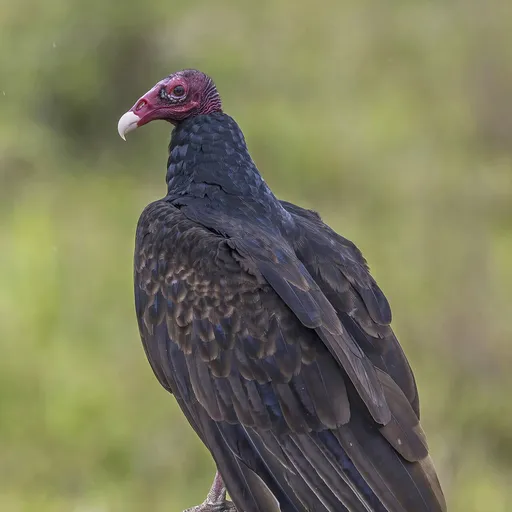
Turkey Vulture
Cathartes aura
Least Concern
Overview
The turkey vulture (Cathartes aura) is the most widespread of the New World vultures, ranging from southern Canada to the southern tip of South America. It is a gregarious scavenger that plays a vital ecological role in the disposal of carrion. Classified as Least Concern on the IUCN Red List, it is one of the most abundant raptorial birds globally.
Identification
- A large bird with a wingspan of 1.5–2 m and a length of 62–81 cm, featuring a small, bald, red head on adults contrasted by brownish-black body plumage.
- The flight feathers appear silvery-gray beneath, contrasting with darker wing linings, while the beak is short, hooked, and ivory-colored.
- Legs are pink-skinned but typically stained white from uric acid; the bird is largely silent, producing only grunts or low hisses due to the absence of a syrinx.
Habitat
It inhabits a variety of open and semi-open areas, including subtropical forests, shrublands, pastures, deserts, and wetlands. The species tends to favor relatively open areas that juxtapose with woodland, which are important for nesting and roosting, while generally avoiding enclosed forested areas that may hamper takeoff. In the United States, it is a permanent resident in the south, though northern populations may migrate as far as South America.
Diet
The turkey vulture feeds almost exclusively on carrion, using its keen sense of smell to locate the ethyl mercaptan gas produced by decaying animals. It forages by flying low to the ground to detect scents below the forest canopy and is often seen along roadsides feeding on roadkill or near bodies of water. It occasionally consumes plant matter, live insects, or dung, but rarely kills prey itself.
Did you know?
The turkey vulture possesses an exceptional sense of smell for a bird, relying on a large olfactory lobe to detect carrion long before sight can identify it, a trait shared by few other avian species. It also practises urohidrosis, defecating on its own legs and feet to cool down through evaporation.
Sources
- Wikipedia · CC BY-SA 4.0
- Wikidata · CC0 1.0