
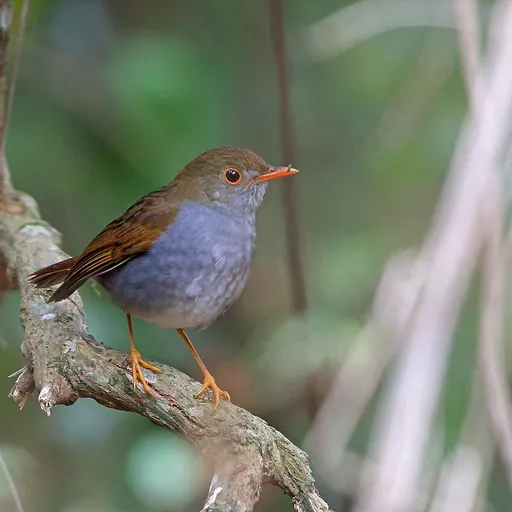
Orange-billed Nightingale-Thrush
Catharus aurantiirostris
Least Concern
Listen
XC757202 · Rosa Elena Albornoz · Cecilio Acosta (near Caracas), Guaicaipuro, Miranda, Venezuela · CC0 1.0
Overview
The orange-billed nightingale-thrush (Catharus aurantiirostris) is a bird species in the family Turdidae. It is a year-round resident in most of its range and is assessed as Least Concern by the IUCN.
Identification
- Adults are olive-brown with a rufous tinge on the crown, nape, back, rump, wings, and tail.
- They possess a long, strong, orange bill and brownish orange legs and feet.
- A thin orange eye-ring surrounds the eyes, and the throat is whitish, darkening to pale grey on the underparts.
- Song varies by subspecies, including scratchy warbling series of sharp whistles and buzzes, such as "chit-TSEE!-tah'wert-PEE'tseee-Cheet".
Habitat
Found from northern Mexico through Central America and into northern South America, it inhabits a variety of forest types in upper tropical and subtropical zones. These include the edges of lowland and montane evergreen forest, as well as pine-oak, deciduous, and secondary forests. In Central and South America, it also occurs in semi-deciduous forest, gardens, coffee plantations, and urban areas.
Diet
Feeds on invertebrates such as insects, spiders, and worms, as well as seeds and berries. It forages in the forest understory and on the ground, where it flips over leaf litter. It has also been observed following army ant swarms in Trinidad.
Did you know?
Although it is primarily a Neotropical species, the orange-billed nightingale-thrush has been documented as a vagrant in the United States, with records from southern Texas in 1996 and South Dakota in 2010.
Sources
- Wikipedia · CC BY-SA 4.0
- Wikidata · CC0 1.0