
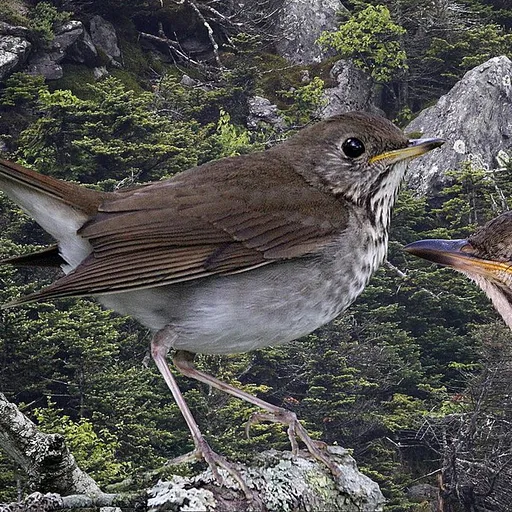
Bicknell's Thrush
Catharus bicknelli
Vulnerable
Listen
XC821143 · Killian Sullivan · Wilmington, Essex County, New York, United States · CC0 1.0
Overview
Bicknell's thrush (Catharus bicknelli) is a medium-sized, vulnerable songbird and one of North America's rarest and most localized species. It is the only bird species whose breeding range is entirely restricted to the northeastern part of the continent. This species forms a cryptic pair with the very similar gray-cheeked thrush.
Identification
- Adults are olive-brown to brownish on the upperparts, contrasting with a chestnut-tinged tail, and have off-white underparts with gray flanks and dusky spots on the breast.
- The bill features a yellow lower mandible with a blackish tip and upper mandible, accompanied by pink legs and a faint grey eye ring.
- The song is a jumbled series of flute-like tones ending on a higher note, composed of phrases such as 'chook-chook, wee-o, wee-o, wee-o-ti-t-ter-ee'.
- It is all but indistinguishable in outward appearance from the gray-cheeked thrush, differing only slightly in size and vocalization.
Habitat
The species is a habitat specialist that breeds on high-altitude coniferous forest tops and highly disturbed habitats in northeastern North America, typically above 915 m. It favours environments with small, stunted trees, such as those affected by strong winds, heavy ice, or recent forestry activity. During migration and winter, it acts as a habitat generalist, inhabiting broadleaf forests in the Greater Antilles, particularly at higher elevations.
Diet
The thrush feeds mainly on insects, particularly beetles and ants, and begins consuming wild fruits in late summer, continuing this diet through migration and winter. It forages primarily on the forest floor by pausing and peering, hopping, or making short flights, though it also gleans insects from foliage and scratches for food on the ground. Individuals eating fruits on wintering grounds forage higher in trees than those eating insects.
Did you know?
Bicknell's thrush has an unusual mating system involving polyandry, where females mate with multiple males, and as many as four males may share duties including feeding nestlings. This polyandrous behaviour is not known to occur in any other thrush species.
Sources
- Wikipedia · CC BY-SA 4.0
- Wikidata · CC0 1.0