
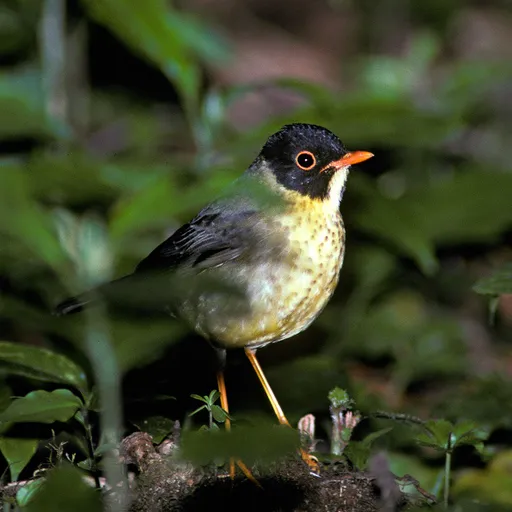
Yellow-throated Nightingale-Thrush
Catharus dryas
Least Concern
Overview
The yellow-throated nightingale-thrush, also known as Gould's nightingale-thrush, is a species of bird in the family Turdidae found from Mexico to Nicaragua. It is currently assessed as a species of Least Concern by the IUCN, though its population is believed to be decreasing due to habitat loss.
Identification
- Males of the nominate subspecies have a mostly black head with an orange eye-ring, a buff chin and upper throat, dull olive-gray upperparts, and an apricot-yellow lower throat, breast, and upper belly with olive spots.
- Females are dark grayish on the back of the crown and head with more olive upperparts, while subspecies C. d. harrisoni and C. d. ovandensis have grayer upperparts and grey spots on their underparts.
- All subspecies possess a dark iris, an orange bill, and orange legs and feet.
- The song is a scratchy warbling series of sharp whistles and buzzes lasting about two seconds, while calls include a sharp, high-pitched whistle or a cat-like contact call.
Habitat
Primarily inhabiting humid tropical and subtropical forest, the species favours damp ravines and areas along forest streams, and in regions south of Mexico also occupies pine-oak forests and higher-elevation coffee plantations. Its range is disjunct, covering parts of Mexico, Guatemala, El Salvador, Honduras, and possibly a small area in extreme northwestern Nicaragua, at elevations between 600 and 3,000 m.
Diet
The specific diet of the yellow-throated nightingale-thrush has not been studied, but it forages low in the forest understory and on the ground, occasionally attending army ant swarms.
Did you know?
The species was originally described in 1855 under the genus Malacochicla before being reassigned to Catharus, and its taxonomy has been unsettled by the recent separation of the speckled nightingale-thrush, formerly treated as subspecies of this bird, following a 2017 study of vocalizations.
Sources
- Wikipedia · CC BY-SA 4.0
- Wikidata · CC0 1.0