
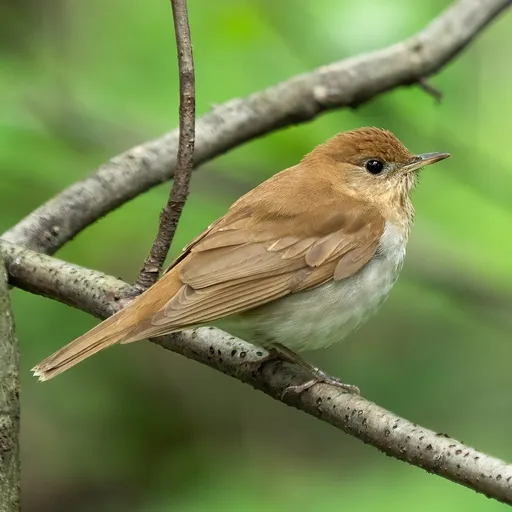
Veery
Catharus fuscescens
Least Concern
Listen
XC420943 · Maxwell Smith · Chautauqua Gorge State Forest (near Mayville), Chautauqua County, New York, United States · CC BY-SA 4.0
Overview
The veery (Catharus fuscescens) is a small North American thrush species within the genus Catharus, also known by the alternate names Wilson's thrush and tawny thrush. It is classified as Least Concern on the IUCN Red List, although breeding populations have shown a decline from 1966 to 2013.
Identification
- Adults feature light brown upperparts, with eastern birds appearing more cinnamon and western birds more olive-brown.
- The underparts are white, with a light tawny breast marked by faint brownish spots.
- The species displays the characteristic under-wing stripe of Catharus thrushes, along with pink legs and a poorly defined eye ring.
- Its song is a breezy, downward-spiraling, flute-like melody, while its common call is a harsh, descending 'vee-er'.
Habitat
Breeding occurs in humid deciduous forests across southern Canada and the northern United States, requiring dense growth and understory close to water sources like streams. The species migrates to eastern South America, with wintering ranges extending to the Amazon basin, Venezuela, and Brazil.
Diet
Veeries forage on the forest floor by flipping leaves to uncover insects and may fly to catch insects in flight. While insects are the primary food source during breeding, fruit and berries make up most of the diet in late summer and fall.
Did you know?
Veeries occasionally engage in interspecific parental care, where a wood thrush has been documented providing more care to veery nestlings than the biological parents, possibly due to sexual solicitation by the female veery.
Sources
- Wikipedia · CC BY-SA 4.0
- Wikidata · CC0 1.0